Singapore Team Building and Corporate Group Activities: An Overview of Formats
An overview of team building and corporate group activity formats in Singapore, from facilitated problem-solving to combat games and escape rooms.
Singapore Team Building and Corporate Group Formats: An Overview
Most first-time planners assume a corporate group can walk into any venue in Singapore with a credit card and a vague headcount. That assumption fails immediately. The commercial reality is that nearly every format here runs on a group-booking model with a minimum group size, a signed safety waiver, and zero walk-in availability. The walk-in model does not exist economically for operators, so it does not exist for you. This is a route map that sorts the landscape by what you are trying to achieve, not by what the pastime is called. You will not find prices, because this site does not sell or quote them. You will not find booking links, because this site does not take them. You will find a plain-spoken catalogue of formats, who each one suits, what goes wrong, and how to pick the right one without learning the lesson the expensive way.
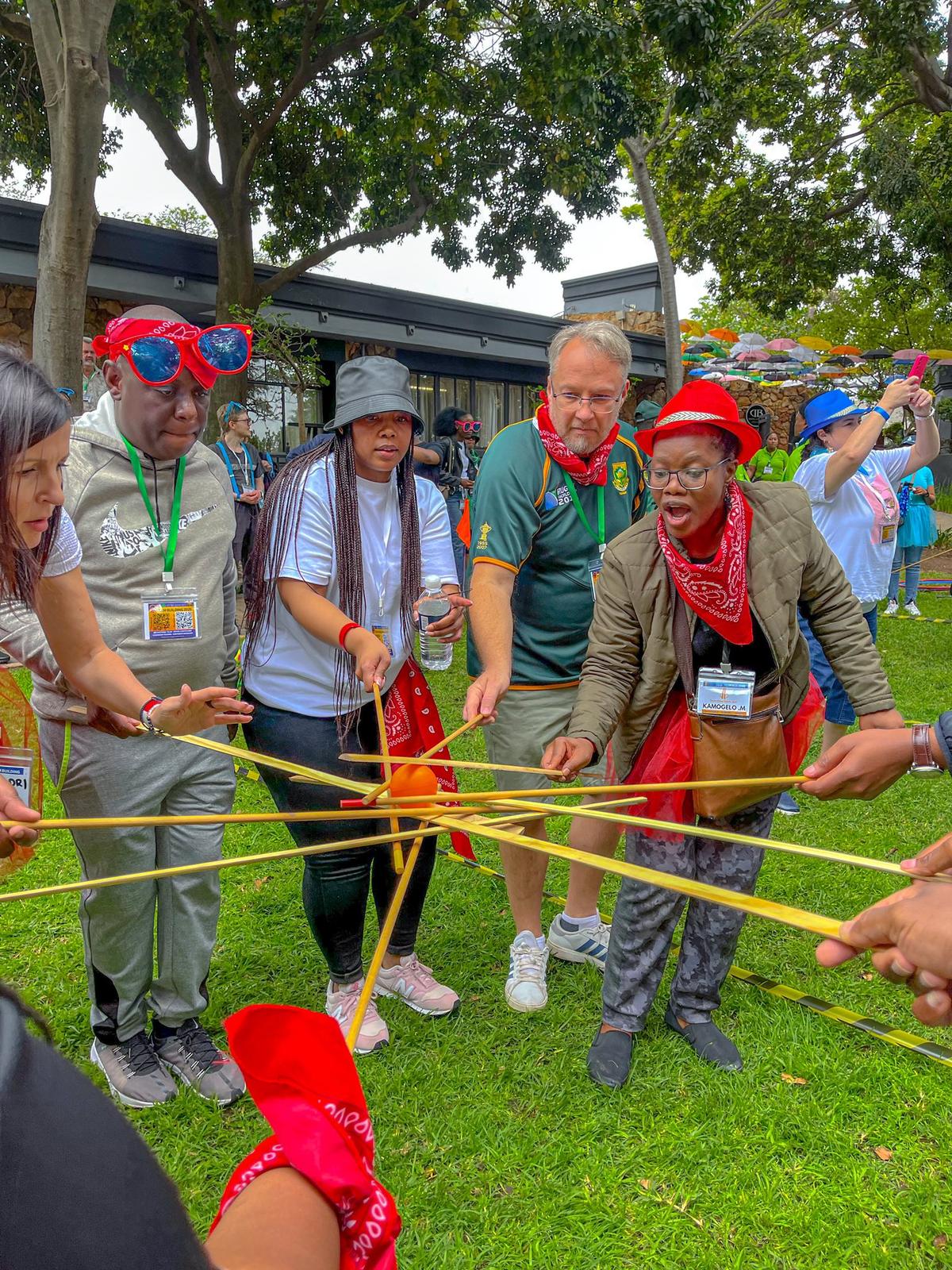

Facilitated Team Building Singapore: The Debrief Is the Product
The single most important distinction on this entire page is the difference between a facilitated team building programme and a corporate fun day. Both are legitimate. They answer different questions. A facilitated programme has a structured debrief built into the schedule. A trained facilitator watches the group work through a problem-solving challenge, takes notes on who led, who withdrew, who broke under pressure, and then leads a conversation that extracts the workplace metaphor from what just happened. That debrief is the product. The challenge is merely the container. A corporate fun day has no such reflection. It is the pastime, full stop, laser tag, bubble soccer, archery tag, with lunch and a prize for the winning team. Neither is superior. The fun day is cheaper per head, easier to run, and perfectly fine if the goal is morale and the team already communicates well. The facilitated programme is the right call when the goal is to surface leadership dynamics, fix a communication breakdown, or give a new team a shared vocabulary for how they work together. Book a fun day hoping for the debrief and you will be disappointed. Book a facilitated programme and skip the debrief because lunch is early and you have paid for something you threw away.
Corporate Group Challenges Singapore: Combat Formats
Combat-focused formats dominate the Singapore market because they are easy to sell to adults who want to shoot each other with safe projectiles and call it strategy. The main options are laser tag, archery tag, and bubble soccer, and they are not interchangeable.
Laser Tag: The Rain-Proof Default
Laser tag is the most forgiving: electronic scoring, no physical projectiles, and predominantly indoor in Singapore, which makes it rain-proof by default. The scoring system sophistication is a real differentiator here. Electronic real-time displays change the competitive dynamic completely. Teams can see the leaderboard shift and adjust tactics mid-round. Group sizes range from four to forty people, with the effective ceiling driven by wait-time between turns rather than any hard limit.
Archery Tag: Honour-Based Scoring
Archery tag looks similar but is a different animal. It uses foam-tipped arrows. That means physical projectiles, a minimum age of seven, eye protection that is mandatory, and an honour-based scoring system that is the single weakest point of the format. Players who do not call their own hits break the game's competitive integrity. In a corporate group where someone is trying to win a gift card, that is a real problem.
Bubble Soccer: Full-Body Collisions
Bubble soccer has no projectiles at all. The appeal is full-body collisions while wearing a giant inflatable zorb. It is the most physically demanding of the three, with a group size range of ten to thirty people, and it is also the one most likely to produce the minor trip injuries that are the format's common currency. None of these games is a strategy exercise. They are exercise with a scoreboard. If you want the strategy, you want a facilitated problem-solving format instead.
Escape Room Team Building Singapore: Timed Puzzles, Sequential Teams
Escape rooms occupy a different category entirely. They are the format most often misbooked by planners who read "group size up to 50" on an operator's website and assume the room holds fifty people. It does not. The room itself holds between two and ten people, depending on the theme. The larger claim refers to rotating multiple teams through multiple rooms simultaneously. That means half your group is waiting in the lobby while the other half solves. The "simultaneous" experience is really a staggered one. The minimum age is seven years, varying by room theme and puzzle complexity, and a typical run lasts forty-five to seventy-five minutes. Safety is a non-issue. Every room in Singapore has an emergency exit button and a clear evacuation procedure. But the format has one quirk that matters for planning: an escape room is non-resettable. Once a team has solved a room, they cannot replay it. A team that races through in twenty-five minutes does not get a second round. The competitive tension is internal, against the clock and the puzzle, not against another team. For team building, the real value is in the debrief: who read the clues, who talked over whom, who went quiet under the countdown timer. A good operator will offer a facilitated debrief on top of the room itself. For corporate groups that is worth the extra cost. For a pure fun day, skip the debrief and let the high-fives carry the energy. Escape rooms are immune to weather, which makes them the default indoor backup venue on a rainy day. They are the format where the distinction between a fixed-arena operator and a mobile operator disappears. Nobody is bringing an escape room to a function room.
Singapore Heritage Team Building Sites: The Non-Game Option
The heritage track is the outlier, because it is the only format where the outing is not a game. The Battle of Singapore (8-15 February 1942) and the fall of the island to Japanese forces is the historical event that ties the sites together. The two most visited locations are the Battlebox and Bukit Chandu.
The Battlebox
The Battlebox, a former underground command centre, is the site of the decision to surrender. It operates as a guided tour only. You cannot wander it alone. Check with the operator for current tour schedules and guide availability.
Bukit Chandu
Bukit Chandu, a hilltop museum run by the National Museum of Singapore, tells the story of the Malay Regiment's last stand. Both are sober experiences. The biggest planning mistake is trying to visit both in a single morning. The sites are far apart, and the emotional weight of the subject matter does not compress well. The more fundamental question is whether a heritage site belongs in a team building itinerary at all. It is not a team building exercise. There is no debrief, no workplace metaphor, no facilitator. It is a group tour with historical depth. The groups that get the most out of it are those who understand that the value is in the conversation it provokes, not in any structured task. If you want the team to bond over a shared experience that has nothing to do with spreadsheets, it works. If you are looking for a problem-solving challenge with a facilitator-to-group ratio you can quote to your CFO, it is the wrong tool. A heritage visit also requires the most weather planning of anything on this page. The Battlebox and Bukit Chandu are both partially exposed. Indoor-only covers the bunker itself, but the approach and the outdoor exhibits are subject to Singapore's downpours. Check the operator's wet-weather plan before you book, not when the sky darkens.
Mobile vs Fixed-Arena Operators Singapore: Choose Your Constraint
The choice between a mobile operator and a fixed-arena operator is a structural one that shapes everything else about your event. A mobile operator brings the equipment to you, a function room, a field, a community centre hard court, and sets up inflatable cover, foam darts, or obstacle-course modules on site. The advantage is that your team never travels. The event can run back-to-back with a meeting or a lunch, and the venue cost is folded into your existing booking. The disadvantage is that you inherit the surface and space constraints of wherever you are. A smooth hall floor is fine for bubble soccer but treacherous for archery tag. An outdoor field can kill a programme entirely if the ground is waterlogged or the lightning risk is high. A fixed-arena operator, by contrast, has built the facility for the pastime. The surfaces are safe, the air-conditioning is on, the safety waivers are already digitised, and the game rotations are slick because the staff have run them a thousand times. The trade-off is that you travel to them, and you are bound by their time slots and their group-size range. For a corporate fun day where the point is to get out of the office, the fixed arena is almost always the better choice. For a team building programme where the point is to control the environment, a dinner, a workshop, a full-day offsite, the mobile operator wins. Which brings up a third consideration: when the mobile operator arrives at your venue, they need a room large enough to lay out the inflatable cover with a safe buffer zone on every side. Planners routinely under-measure the space. The operator arrives to find a function room that fits the equipment but not the people. Measure the room before you book, and confirm the operator's own square-metre requirement in writing.
Singapore Corporate Event Planning: Weather, Waivers, and Reality
Singapore's climate is the hidden variable in every outdoor booking. The mistake newcomers make is assuming "outdoor" means "weather-proof" because the operator said play continues in light rain. That is advertising, not evidence. The hard constraint is the PUB lightning advisory, which requires outdoor pastimes to cease when lightning is within six to eight kilometres. That is a hard stop, not a judgement call, and it can end a programme with zero warning. Wet surfaces add a second risk: slip injuries. Operators who run archery tag and bubble soccer outdoors carry a higher insurance premium and pass that cost on to you. The practical consequence is that every outdoor booking needs a wet-weather plan confirmed before you book. The plan might be a move to an indoor backup venue (laser tag and escape rooms are unaffected by weather), or it might be a postponement to a rain date. What it cannot be is a surprise. Ask the operator, in writing, what happens if lightning is in the area at the start of your time slot. If the answer is "we'll reschedule" and you have a one-day window, you have an expensive gap. The other climate variable is the humidity, which is extreme year-round. A half-day programme of archery tag in the afternoon sun is a different experience from the same pastime in the evening. Group fitness levels matter more than any marketing copy admits. For a mixed-fitness group, the indoor options, laser tag, escape rooms, indoor archery tag, are the safe choice because the air-conditioning is a feature, not an afterthought.
Team Building Formats Singapore: Match the Group Size to the Format
Group size is the axis on which every decision turns. The numbers that matter are the ones the operator gives you, not the ones you wish were true. The group size range for each format is a real constraint: archery tag runs eight to thirty people, laser tag four to forty, bubble soccer ten to thirty, nerf and combat games eight to forty, and escape rooms two to ten per room. The effective ceiling is always lower than the advertised maximum, because the ceiling is where wait-time between turns becomes unacceptable. An archery tag group of thirty means each player cycles through a dozen rounds. The downtime between turns is where energy dies. For a corporate fun day, the planner's job is to pick the format whose maximum leaves at least a twenty percent buffer on the expected headcount. Confirmed attendees are always fewer than invitees. And here is the failure mode that ends events: booking the wrong group size by counting total invitees rather than confirmed attendees. An escape room booked for ten that only fits eight means two people stand idle, or the whole group is turned away at the door. For nerf and combat games, the minimum age is six years, driven by insurance requirements and equipment sizing. The safety gear is eye protection, mandatory, no exceptions. The common injuries are minor trips and, when someone removes goggles, eye irritation. The facilitator-to-group ratio is the second number that matters, and it is the one most operators understate. A ratio of one facilitator per fifteen to twenty-five people is the industry standard for team building programmes. A booking at one-to-fifteen that arrives with one-to-thirty has doubled the wait times and halved the safety oversight. Ask for the ratio in writing, and ask what the ratio is when the group is at the maximum advertised size. If the operator will not commit to a number, that is your answer.
Singapore Team Building Cost Drivers: What You Are Actually Paying For
The cost structure of a team building programme is opaque because operators quote a package price. The underlying drivers are consistent, and knowing them tells you what to negotiate on. The first driver is group size. Per-head cost decreases with scale. The operator's fixed costs (facilitator, equipment, venue) are spread across more people. The second is facilitator count: more facilitators means tighter safety and faster game rotations, but it is also the largest live cost on the operator's books. The third is venue, and this is where the fixed-arena versus mobile decision bites. Indoor venues in Singapore command a premium, especially in the central business district, and that premium appears in your quote. The fourth is equipment and materials: archery tag arrows need replacing, bubble soccer zorbs are expensive to repair, and escape rooms are resettable but not free. The fifth is customisation level, and this is the one most under-utilised. A bespoke programme customisation, where the operator tailors the games to your team size, objectives, and industry, costs more than an off-the-shelf package. It is also the difference between a generic afternoon and a programme your team actually talks about. The sixth is duration: a half-day programme runs two to four hours, a full-day runs six to eight. The per-hour cost drops the longer you go because the fixed costs are amortised. What none of this tells you is a price. Prices change, venues renegotiate, and this site does not sell them. What it tells you is where the negotiation room is. If the quote is too high, ask what changes when you drop the customisation, reduce the facilitator count, or move to a Tuesday morning slot. The operator would rather discount a slow slot than lose the booking entirely.
Nerf and Combat Games Singapore: The Full-Contact Option
Nerf and combat games deserve a section of their own because they are the format where the gap between expectation and reality is widest. The marketing shows an eight-year-old gleefully dodging foam darts. The corporate reality is a group of adults in business-casual who have been told to run, and the injury that ends the day is not a collision but a twisted ankle from a surface that was not checked. The minimum age is six years, which makes this the default choice for kids' birthday parties. For a corporate group the age range is less important than the fitness range. The safety gear is eye protection, mandatory. The common injuries are minor trips and, when someone removes the goggles, eye irritation. The indoor/outdoor split is both: it runs in a fixed arena or a mobile operator brings the inflatable cover to you. The weather contingency is to move indoors or postpone, which means the wet-weather plan is the same as every other outdoor pastime. The group size range is eight to forty people, and the effective ceiling is where the wait-time between turns becomes unacceptable. For a forty-person group, that is a lot of turns. The failure mode that stalls play is nerf dart loss: operators provide a fixed dart count with no on-field replenishment. Within thirty minutes half the darts are under a desk or behind a curtain. Ask the operator how many darts are in play per person, and what the replenishment policy is. A ratio of twenty darts per player is a floor, not a ceiling. The other failure mode is the one that ends any combat game: a player who cannot be tagged or cannot score breaks the game's competitive integrity. In a group where someone is overly competitive, or someone else is wholly disengaged, the facilitator's job is to manage the social dynamic, not just the safety. That is why the facilitator-to-group ratio matters in this format more than any other. The game only works when the facilitator is present and watching the dynamics, not just the darts.
Kids' Birthday Party Activities Singapore: The Group Booking Reality
Kids' birthday parties are the other major market for these formats. The requirements are different enough that they deserve their own mention. The minimum age for most combat games is seven years, driven by insurance and equipment sizing, though some operators run archery tag from age six with a parent on the field. The typical group size range is ten to thirty children. The safety requirement for under-sevens is an adult supervision ratio of one to five. That is the operator's rule, not a suggestion. The common formats are archery tag, laser tag, bubble soccer, nerf, escape rooms, and craft workshops. The mix is almost always both indoor and outdoor. The rainy-day options are the indoor ones: laser tag, escape rooms, indoor archery tag, indoor nerf, and indoor bubble soccer. That is the full list. If the party is on a Saturday afternoon in November, the operator's indoor backup venue is the difference between a party and a refund. The failure mode for kids' parties is not the pastime itself. It is the party room. Parents expect a room to serve cake, and not every operator has one. The food-and-cake policy varies: some allow outside food, some require you to buy from their menu, and some charge a corkage fee that exceeds the cost of the cake. Ask before you book. Confirm that the party room is separate from the play area. A room full of sugared-up seven-year-olds does not calm down just because the laser tag round is over. The other failure mode is the birthday child, the one who loses, or who is not the best at the game, and who melts down in front of friends. A good operator's facilitators are trained to handle this. A bad operator just supervises. Ask what the facilitator-to-child ratio is for the party, and whether the facilitators are experienced with children or just with the game. The answer tells you whether you are getting a party or a gamble.
School Group Activities Singapore: Ratios, Waivers, and Backup Plans
School and uniformed-group coordinators face a different set of constraints. The most important is the safety ratio. The facilitator-to-group ratio for adventure pastimes is one facilitator per fifteen to twenty-five people, but for schools the ratio is often stricter, dictated by the Ministry of Education's outdoor education guidelines rather than the operator's own staffing. Ask the operator for their school-specific ratio. Ask what the ratio is for a cohort of forty versus a cohort of one hundred. The second constraint is the wet-weather plan, which for a school trip is not negotiable. The trip happens on a fixed date. There is no rescheduling to avoid the monsoon season. The operator's answer to "what happens if it rains?" must include a specific indoor backup venue, not a vague promise to reschedule. The third constraint is historical depth: for heritage sites, the curriculum link is real, but the quality of the visit depends entirely on the guide. The Battlebox and Bukit Chandu are both run by organisations with professional guides, but the historical depth scale, plaque-only, site-with-panels, guided-narrative, varies by site and by visit format. The fourth constraint is group size. A single class of thirty is at the low end of most combat formats, so the school child who is quietly solving problems is the one who gets left out. The fifth constraint is the one most coordinators forget: the safety waiver. Every combat pastime requires a signed liability waiver, and for under-18s the waiver must be signed by a parent or guardian. Collecting a hundred signed waivers on the morning of the trip is a failure mode that ends the day before it starts. Collect them a week in advance. Have the coordinator carry the physical copies or a verified digital list. The final constraint is true of everything on this page: the Singapore team building industry has high churn. A venue operating last year may not be operating this year. Call to confirm the operator is still in business. Ask for the name of the specific facilitator who will run your programme, not the name of the company.
Singapore Team Building Industry Standards: The Fine Print
There is no single licensing body for the Singapore team building industry. Individual operators follow sector-specific safety codes. The relevant standard for adventure pastimes is SS 628:2021, published by the national standards body. For indoor venues, the SCDF fire safety requirements for public entertainment venues apply. The insurance requirement is public liability insurance, which is standard for event operators. The operator should be able to show you a certificate of insurance on request. If they cannot, that is a red flag. The other verification that matters is the one not on any website: the actual condition of the equipment. A foam dart with a split seam, a bubble soccer zorb with a patched hole, a laser tag vest with a faulty sensor, these are the differences between a programme that feels premium and one that feels like a car boot sale. Ask the operator when the equipment was last audited. Ask what the replacement schedule is. A good operator will tell you; a defensive one will not. The last thing to say on verification is the thing this site cannot give you: a current price list. Prices change, packages get renegotiated, and the figure you see on a review site from last year is already stale. The one thing that is stable is the structure: the group size minimums, the facilitator ratios, the wet-weather plans, the safety waivers. That is the contract, and it is the contract this page is built on. The price is the variable you will negotiate yourself.
Where to Start: The Case for Facilitated Programmes
The most overrated team building option in Singapore is the one with the highest production value. It is not that the pastime is bad. It is that the pastime is a stage set, and the facilitation is the play. A corporate fun day at a fixed-arena laser tag venue, with electronic scoring and a trophy lunch, is the easiest sell in the industry because it does not require the buyer to believe in anything. But the teams that leave the fun day having actually changed how they work together are rare. The teams that leave the facilitated programme having changed something are common. The reason is the debrief. The debrief is where the workplace metaphor lands, where the quiet person who solved the puzzle is finally heard, where the manager who took over sees the video of themselves not listening. Without the debrief, the pastime is just exercise. With it, the pastime is a mirror. So the recommendation is this: if your team is new, or struggling, or has never worked together before, book the facilitated team building programme. Book the one with the best facilitator-to-group ratio you can afford. If your team is established, functional, and just needs a morale boost, book the fun day. Book the one with the best air-conditioning. And if you are booking an outdoor pastime, book it for the morning, before the heat and the lightning. Have the indoor backup venue confirmed before you pay a deposit. That is the advice that comes from watching thirty groups make the same mistakes. Start with the facilitated programme. It is the harder conversation, and it is the one that matters.
- Group size range (archery tag): 8-30 participants
- Group size range (laser tag): 4-40 participants
- Group size range (bubble soccer): 10-30 participants
- Group size range (nerf/combat): 8-40 participants
- Group size range (escape room, per room): 2-10 participants
- Minimum age (nerf/combat): 6 years, varies by operator and activity
- Minimum age (escape rooms): 7 years, varies by room theme
- Escape room session duration: 45-75 minutes
- Team building session duration: 2-8 hours (half-day to full-day)
- Team building group size range: 10-200+ participants
- Typical facilitator-to-group ratio: 1 facilitator per 15-25 participants
- Adventure activities safety standard: SS 628:2021 (Singapore)
More in Team building and corporate events
-
 Active vs low-impact activities for mixed teams
Comparing active and low-impact team building activities in Singapore for mixed teams: how to include reluctant participants and avoid dropout.
Active vs low-impact activities for mixed teams
Comparing active and low-impact team building activities in Singapore for mixed teams: how to include reluctant participants and avoid dropout.
-
 Facilitated vs self-run activities
The difference between a facilitated team building session with a debrief and a self-run activity in Singapore, and when the facilitator is worth the cost.
Facilitated vs self-run activities
The difference between a facilitated team building session with a debrief and a self-run activity in Singapore, and when the facilitator is worth the cost.
-
 Half-day vs full-day programme structures
How half-day and full-day team building programmes in Singapore differ in active play time, structure, and how to avoid afternoon fatigue in the heat.
Half-day vs full-day programme structures
How half-day and full-day team building programmes in Singapore differ in active play time, structure, and how to avoid afternoon fatigue in the heat.
-
 Heritage and history-based team outings
How to plan a heritage or WWII history team outing in Singapore, from Battlebox guided tours to coastal gun sites, with session flow and what drives the cost.
Heritage and history-based team outings
How to plan a heritage or WWII history team outing in Singapore, from Battlebox guided tours to coastal gun sites, with session flow and what drives the cost.
-
 How to choose a team-building format by goal (bonding, competition, learning)
How to match a Singapore team building format to your goal: bonding through shared experience, competition with clear winners, or learning via facilitated debrief.
How to choose a team-building format by goal (bonding, competition, learning)
How to match a Singapore team building format to your goal: bonding through shared experience, competition with clear winners, or learning via facilitated debrief.
-
 Inclusivity: fitness, religion, dietary needs, injuries
How to plan team activities in Singapore that include different fitness levels, religious practices, dietary needs, and physical accessibility requirements.
Inclusivity: fitness, religion, dietary needs, injuries
How to plan team activities in Singapore that include different fitness levels, religious practices, dietary needs, and physical accessibility requirements.
-
 Planning for 20, 50, 200+ staff
How team building logistics in Singapore change at 20, 50, and 200+ staff: rotation formats, wait-time dynamics, and when single-activity models break.
Planning for 20, 50, 200+ staff
How team building logistics in Singapore change at 20, 50, and 200+ staff: rotation formats, wait-time dynamics, and when single-activity models break.
-
 Price drivers and what "per pax" quotes usually exclude
What drives the cost of team-building activities in Singapore, from headcount minimums and facilitator ratios to what per-head quotes usually exclude.
Price drivers and what "per pax" quotes usually exclude
What drives the cost of team-building activities in Singapore, from headcount minimums and facilitator ratios to what per-head quotes usually exclude.
-
 Rainy-season contingency planning
How to build a wet-weather contingency plan for outdoor team building during Singapore's monsoon seasons, including PUB lightning rules and backup venue strategy.
Rainy-season contingency planning
How to build a wet-weather contingency plan for outdoor team building during Singapore's monsoon seasons, including PUB lightning rules and backup venue strategy.
-
 Unusual event venues in Singapore (historic sites, rooftops, islands)
Unusual Singapore venues for team building—historic sites, rooftops, islands—and the constraints each imposes on weather backup, permits, and logistics.
Unusual event venues in Singapore (historic sites, rooftops, islands)
Unusual Singapore venues for team building—historic sites, rooftops, islands—and the constraints each imposes on weather backup, permits, and logistics.
-
 Writing an RFP or brief for activity providers
What to include in a brief or RFP to Singapore team-building providers so you get comparable proposals covering headcount, wet-weather backup, and cost exclusions.
Writing an RFP or brief for activity providers
What to include in a brief or RFP to Singapore team-building providers so you get comparable proposals covering headcount, wet-weather backup, and cost exclusions.
Read next
-
How to choose a team-building format by goal (bonding, competition, learning)
How to match a Singapore team building format to your goal: bonding through shared experience, competition with clear winners, or learning via facilitated debrief.
-
Unusual event venues in Singapore (historic sites, rooftops, islands)
Unusual Singapore venues for team building—historic sites, rooftops, islands—and the constraints each imposes on weather backup, permits, and logistics.
-
Rainy-season contingency planning
How to build a wet-weather contingency plan for outdoor team building during Singapore's monsoon seasons, including PUB lightning rules and backup venue strategy.
-
Half-day vs full-day programme structures
How half-day and full-day team building programmes in Singapore differ in active play time, structure, and how to avoid afternoon fatigue in the heat.
-
Active vs low-impact activities for mixed teams
Comparing active and low-impact team building activities in Singapore for mixed teams: how to include reluctant participants and avoid dropout.
-
Price drivers and what "per pax" quotes usually exclude
What drives the cost of team-building activities in Singapore, from headcount minimums and facilitator ratios to what per-head quotes usually exclude.