The Battlebox History Explained: Malaya Command and the Surrender of Singapore 15 February 1942
The Battlebox History Malaya Command Surrender 15 February 1942
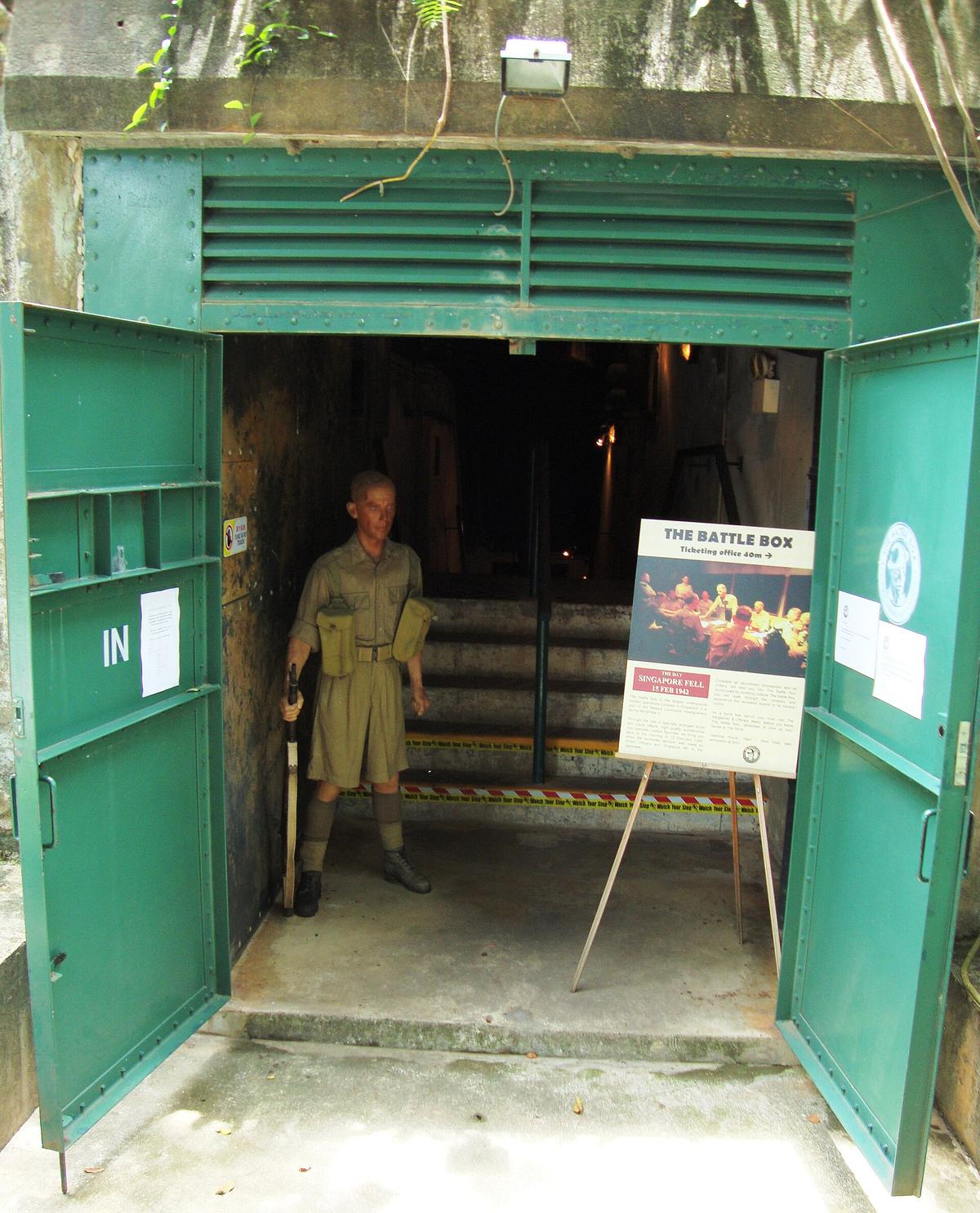
The most common mistake about the Battlebox is that it was a static museum where visitors browse exhibits at their own pace. It is not. The Battlebox is a guided-tour-only bunker. You walk through the exact rooms where Lieutenant-General Arthur Percival made the decision to surrender Singapore on 15 February 1942. The battlebox history malaya command surrender 15 february 1942 is the sole reason this site exists as a heritage attraction. The bunker was built in 1939 as the Fort Canning Command Centre, buried approximately 9 metres below ground with 26 rooms and a floor area of roughly 1,666 m². Every tour is a chronological walk through the military collapse that led to that single meeting in the Commander's Office.
Lieutenant-General Arthur Percival Surrender Decision
The surrender decision was made at approximately 09:30 on 15 February 1942 inside the Commander's Office of the Malaya Command headquarters. Percival had already moved his command underground after the Japanese bombed the surface buildings. The meeting included his senior staff: Major-General Frank Keith Simmons and Brigadier K.S. Torrance. The Japanese had captured the water reservoirs at MacRitchie, Peirce, and Seletar. Without water, the civilian population of roughly one million people could not hold out. Churchill had instructed Percival to fight to the last. Percival judged that continued resistance would cause mass civilian death by thirst and shelling. He authorised the surrender. The document was signed later that day at approximately 18:10 at the Ford Motor Factory in Bukit Timah.
Malaya Command Underground Headquarters Fort Canning
Inside The Bunker
The Malaya Command underground headquarters at Fort Canning was the nerve centre of British military operations in Malaya and Singapore from 1939 to 1942. The bunker had its own generator, telephone exchange, cipher room, and map room. The 26 rooms included sleeping quarters for the duty staff, a signals room, and the Commander's Office where Percival met his staff. The bunker is not air-conditioned to typical museum standards; it is mechanically ventilated and dehumidified. Expect it to be warm and humid. The entry stairs are steep and uneven, and the bunker is not wheelchair accessible. Wear covered shoes.
Tours And Practicals
The site is operated by Global Cultural Alliance (GCA), appointed in 2023. Check with the operator for current details. The standard guided tour is called "A Story of Strategy & Surrender" and lasts approximately 60 minutes. Maximum group size is 30 persons. Minimum recommended age for the standard tour is 7 years. Photography is permitted but flash is not.
| Tour Type | Maximum Group Size | Duration | Booking Lead Time | Best For |
|---|---|---|---|---|
| Public Guided Tour | 30 persons | ~60 minutes | Same-day online booking | Individual visitors and small groups |
| Private Guided Tour | 30 persons | ~60 minutes | Minimum 5 days advance booking | Corporate groups, school cohorts, heritage societies |
| Educational Rate Tour | 30 persons | ~60 minutes | Minimum group size applies | Schools and uniformed groups with curriculum links |
Battle of Singapore Timeline 8 to 15 February 1942
The Battle of Singapore lasted eight days, from the Japanese landings on the north-west coast on 8 February to the surrender on 15 February. The timeline inside the Battlebox tour follows this sequence:
- 8 February: Japanese 5th Division and 18th Division land near Sarimbun Beach. Australian 22nd Brigade is overwhelmed.
- 9 February: Japanese capture Tengah Airfield. Percival moves command to the Battlebox bunker.
- 10-11 February: Japanese push to Bukit Timah. The Malay Regiment fights its last stand at Pasir Panjang Ridge.
- 12-14 February: Japanese capture the water reservoirs. Shelling of the city intensifies. Civilian casualties mount.
- 15 February: 09:30 meeting in the Commander's Office. Percival decides to surrender. 18:10 signing at Ford Motor Factory.
Who Lost Singapore Debate Historical
The "who lost Singapore" debate has occupied historians for decades. The primary-source documents held at the Battlebox and the National Archives of Singapore show multiple factors. The seaward-facing coastal guns at Labrador Battery and Fort Siloso could not be turned inland quickly enough to stop the landward invasion. The naval base defence strategy assumed the Royal Navy could reinforce the island. The sinking of HMS Prince of Wales and HMS Repulse on 10 December 1941 ended that. The fortress Singapore myth, that the island was impregnable from the sea, meant the landward defence was underprepared. Churchill's instruction to fight to the last conflicted with the reality that the civilian population was running out of water. Percival bore the final responsibility, but the chain of failures stretched from London to Singapore.
Battlebox Bunker Rooms and Functions WWII
The 26 rooms of the Battlebox each served a specific function during WWII. The key rooms you will see on the tour include:
- The Commander's Office: Where Percival made the surrender decision at 09:30 on 15 February 1942.
- The Cipher Room: Encrypted communications between Malaya Command and London.
- The Map Room: Troop movements plotted daily; the map on display shows the final defensive positions.
- The Signals Room: Radio and telephone links to all units in the field.
- The Duty Officer's Quarters: Sleeping and living space for the rotating watch staff.
Every room has interpretive panels placed by the National Heritage Board. The curatorial interpretation draws on primary-source documents from the National Archives of Singapore, including Percival's own despatches and the Japanese perspective from General Yamashita's staff records.
Fortress Singapore Myth and Coastal Gun Orientation Seaward
The fortress Singapore myth held that the island was a naval fortress protected by massive coastal guns pointing out to sea. The guns at Labrador Battery and Fort Siloso were oriented seaward to defend against a naval attack. When the Japanese invaded from the north, down the Malay Peninsula and across the Johor Strait, the guns could not be traversed inland quickly or effectively. Some guns could fire inland but had only armour-piercing shells designed for ships, not high-explosive shells for troops. The landward defence strategy was built on the assumption that the jungle of Johor was impassable. The Japanese proved that assumption wrong by using bicycles and light tanks to move rapidly down the peninsula. Visit Labrador Battery to see the gun emplacements still facing the sea, exactly as they were.
Civilian Population Consideration and Water Supply Surrender Factor
Percival's surrender decision was driven heavily by the water supply situation. The Japanese had captured the reservoirs at MacRitchie, Peirce, and Seletar by 14 February. The civilian population of the city was approximately one million people, and the piped water supply was failing. Without water, the city would face a humanitarian catastrophe within days. Churchill's instruction had been to fight to the last. Percival judged that continued resistance would cause mass civilian death by thirst and shelling. The water supply factor is a primary-source documented reason for the surrender, not a post-war justification. The National Archives of Singapore holds the original water supply reports from 14-15 February 1942.
POW Captivity Changi and Japanese Occupation
The Surrender's Aftermath
After the surrender, British, Australian, Indian, and local troops became prisoners of war. Most were marched to Changi Prison and the surrounding barracks, where they would remain for the next three and a half years. The Japanese Occupation of Singapore lasted from 15 February 1942 until the Japanese surrender in September 1945. The POW captivity experience is documented at the Changi Chapel and Museum, which focuses on the internment experience through artefacts, letters, and recorded oral histories.
How To Sequence Your Visit
The Battlebox tour does not cover the occupation in depth; it ends with the surrender. For the full narrative from invasion to occupation to liberation, visit both sites in sequence. Do Battlebox first for the command perspective, then Changi Chapel and Museum for the prisoner experience.
Primary-Source Document and Curatorial Interpretation National Heritage Board
The curatorial interpretation at the Battlebox is overseen by the National Heritage Board (NHB), which sets the interpretive standards for the site. The exhibits draw on primary-source documents from the National Archives of Singapore, including Percival's despatches, the Japanese surrender terms, and the water supply reports. The NHB also operates Reflections at Bukit Chandu, the site of the Malay Regiment's last stand, and the Changi Chapel and Museum. The Battlebox is not an NHB-operated site. It is run by Global Cultural Alliance under a lease from NParks. But the content is reviewed against NHB's historical standards. This means the narrative you hear is based on documented evidence, not oral tradition or popular myth.
What the Reader Should Do Next
Book the Battlebox tour online. For a private group tour, book at least 5 days ahead. For the public tour, book at least 24 hours ahead. Arrive 10 minutes early to check in at the entrance at 2 Cox Terrace. Wear covered shoes for the uneven floors. Do not bring food or drinks inside the bunker. The single thing that most often goes wrong: visitors arrive expecting a self-guided museum and find they must wait for the next scheduled tour, which may be fully booked. Avoid that failure. Book online before you arrive.
Common Questions
Can I visit the Battlebox without a guided tour?
No. The Battlebox is guided-tour only. There is no self-guided walkthrough. Every visitor must join a scheduled tour. Book in advance online; same-day walk-ins are rarely accommodated.
Is the Battlebox suitable for children?
The minimum recommended age for the standard tour is 7 years. The tour involves standing for 60 minutes in a confined underground space with no natural light. Younger children may find it frightening or boring.
How do I get to the Battlebox?
Take the MRT to Fort Canning station (Downtown Line), Exit B. Walk approximately 2 minutes to 2 Cox Terrace. There is no dedicated on-site parking; the nearest public carpark is in Fort Canning Park.
What happens if it rains?
The Battlebox is fully underground and unaffected by rain. The outdoor queue area is shaded. Rain does not affect tours. This is one of the few heritage sites in the city that is weather-independent.