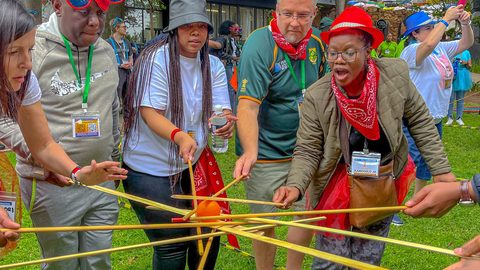
Active Versus Low-Impact Singapore Team Building Activities for Mixed-Ability Groups
Comparing active and low-impact team building activities in Singapore for mixed teams: how to include reluctant participants and avoid dropout.
Active vs Low-Impact Team Building Singapore Mixed Teams: Which Format Keeps Everyone Playing?
You booked bubble soccer for your team of 20, and by minute 15 three people were standing on the sideline pretending to stretch. By minute 30 the score was 8-2 and the person who hated contact sports was hiding behind the inflatable barrier. This is the core failure of mixing active and low-impact activities in a single event: the format itself determines who drops out. The question is not about which activity is more fun. It is about whether the least-enthusiastic person in your group has a genuine path to participate without becoming a spectacle.
High-intensity formats produce rapid dropout among reluctant or less-fit participants because they offer no off-ramp. Low-impact alternatives such as escape rooms, heritage tours and laser tag keep everyone engaged because the exertion is flat and the social cost of opting down is zero. The key variable is not the activity's stated intensity but the presence of a genuine opt-out path: a non-player viewing area, a substitute rotation system, or a facilitator who can adjust game modes to reduce contact. Without that, your budget buys a session where half the team watches and the other half gets injured.
Mixed Fitness Team Building Singapore: The Physical Intensity Scale You Need Before Booking
Every activity falls on an intensity scale that ranges from sedentary problem-solving to high-intensity bursts with collision risk. The mistake organisers make is assuming that everyone in a mixed-age or mixed-fitness team will tolerate the same level. They will not. A team with a 55-year-old manager who had knee surgery last year and a 23-year-old intern who plays weekend football needs a format that accommodates both without singling out either.
High-Intensity Combat Formats and Their Risks
On the high-intensity end, bubble soccer demands full-speed collisions inside a zorb suit that restricts lower-leg movement, creating a documented ankle and knee injury risk. Paintball carries the highest sting of any combat format, gelatin capsules fired from CO2 markers that leave visible splats and require signed safety waivers. Archery tag uses foam-tipped arrows with a 20-30 lb draw weight; the sting is low but the finger-pinching risk is real, and many 7-year-olds lack the draw strength to fire the arrow more than a few metres. Laser tag, by contrast, uses infrared emitters with no projectiles, zero pain and electronic real-time scoring. It is the only combat game where a player can participate fully with no contact and no sting.
Low-Impact Choices and Their Trade-offs
On the low-impact side, escape rooms offer a purely cognitive challenge inside an air-conditioned room for 60-75 minutes. The team size per room is 2-10 persons; larger groups rotate through multiple rooms, which means half the party waits. Heritage tours at sites such as the Battlebox bunker, Changi Chapel and Museum and Reflections at Bukit Chandu operate at a walking pace with indoor, air-conditioned exhibits. The historical depth at these sites is substantial. The Battlebox is the actual underground command centre where Lieutenant-General Arthur Percival surrendered Singapore on 15 February 1942, but the physical demand is negligible. A heritage tour will not cause a reluctant participant to drop out. It will cause someone who wanted paintball to check their phone. That is a trade-off you manage with the booking, not with the activity.
Low-Impact Corporate Activities Singapore: What Actually Works for Mixed-Ability Groups
The low-impact corporate landscape splits between facilitated problem-solving and guided heritage walks. Both share one structural advantage: they eliminate the dropout problem entirely because there is no physical barrier to entry.
Escape Rooms: Scaling Without the Wait
Escape rooms are the most scalable low-impact option for groups up to 50 persons, provided you accept the rotation logic. A single room holds 6-10 people; booking three rooms simultaneously for 60 minutes means every participant is solving puzzles for the full session with no wait time. The cognitive challenge is real. The room's narrative immersion and puzzle difficulty determine whether the team works together or fragments, and the session ends with a clear outcome: escaped or not. The failure case is booking a single room for a group of 12, which leaves 2-4 people standing idle. Book the number of rooms your confirmed attendee count requires, not the number your invite count suggests.
Heritage Tours: Know What You Are Buying
Heritage tours at sites managed by the National Heritage Board operate with guided narratives that range from a docent with primary-source training to an audio guide on a lanyard. The term 'guided tour' is unregulated in Singapore's heritage sector, so confirm the format before booking (check with the operator). The Changi Chapel and Museum reopened in 2021 with self-guided exhibits that take 60-90 minutes and focus on the POW and civilian internment experience. Reflections at Bukit Chandu covers the Malay Regiment's last stand at Pasir Panjang ridge in a single bungalow setting with air-conditioned galleries. Both sites are fully accessible and require no exertion beyond walking. For a team that includes wheelchair users, check the accessibility rating: Fort Canning Park and Bukit Chandu have steps and slopes that limit access, while Changi Chapel and Museum is fully accessible.
| Activity | Physical Intensity | Sting/Pain Level | Dropout Risk Among Reluctant Participants | Indoor Backup Available |
|---|---|---|---|---|
| Bubble Soccer | High (bursts) | Medium (collisions) | High: continuous play cap; suit restricts lower leg | No (outdoor or sports hall) |
| Paintball | Medium-High | High (visible splat) | High: highest sting; fogged goggles stop play | No (outdoor or semi-sheltered) |
| Archery Tag | Medium | Low (foam tip) | Medium: draw strength barrier for small participants | Both indoor and outdoor |
| Laser Tag | Low-Medium | None | Low: zero physical contact; darkened arena trips risk | Yes (indoor, air-conditioned) |
| Escape Room | Low | None | None: cognitive challenge only; wait-time risk if overbooked | Yes (indoor, air-conditioned) |
| Heritage Tour | Low (walking) | None | None: walking pace; outdoor sites have heat risk | Partial (some sites indoor) |
Active Team Building Reluctant Participants Singapore: Why Opt-Out Paths Matter More Than Activity Choice
The reluctant-participant problem is not solved by choosing a low-impact activity. It is solved by choosing a format that contains a genuine opt-out path. An opt-out path is not a bench where the reluctant participant sits alone watching everyone else collide. It is a structural feature of the session that allows a person to participate at a lower intensity without becoming a spectacle.
Three opt-out mechanisms work in practice:
- Non-player observation area: A designated space where a participant can watch and rejoin later without being asked why they stopped. This exists at fixed-arena laser tag operators and some paintball venues, but not at bubble soccer fields where the sideline is the same space as the playing area.
- Substitute player rotation: A system where players swap in and out on a timer, so the least-enthusiastic person plays two minutes out of every ten rather than being eliminated permanently. This is standard in facilitated sessions but rare in combat games, where elimination is the game mechanic.
- Facilitator-adjustable game modes: A facilitator who can reduce contact, lower the number of active players per side, or switch to a non-elimination mode. This requires an operator with a facilitator-to-participant ratio of 1:10 to 1:15 and a customisation policy that goes beyond a fixed-package menu (check with the operator).
If the operator cannot confirm any of these three mechanisms before you pay the deposit, the session will produce a dropout. Confirm the opt-out path in writing before you send the deposit. The minimum advance booking notice for groups over 20 persons is 7-14 days.
Pre-Existing Injury Disclosure and the Safety Waiver
Every combat activity in Singapore requires a signed liability waiver. The waiver is an insurance-driven constant across operators, but the disclosure process is not standardised. Before booking, survey the team for pre-existing injuries, comfort levels and any sensory sensitivity that might affect participation. Bubble soccer's zorb suit is enclosed and shared; sweat and odour are a persistent hygiene complaint that no operator has fully solved. Paintball's CO2 markers produce a loud report that can trigger sensory issues. Laser tag's darkened arena with fog machines and flashing lights is a known trigger for photosensitive epilepsy. Disclose these specifics in the pre-event survey, not after arrival.
Weather Dependency and the Indoor Backup Plan
Singapore's monsoon seasons, Northeast monsoon from December to early March, Southwest monsoon from June to September, bring predictable heavy rain. The inter-monsoon periods in April, May and October, November produce heavier afternoon showers between 2 pm and 6 pm. The PUB lightning advisory requires all outdoor activities to cease when lightning is within 6-8 km. This is a hard stop, not operator discretion. If you book an outdoor-only activity such as bubble soccer or paintball without confirming the operator's wet-weather policy, you risk losing your deposit and having a group with nowhere to go. Indoor air-conditioned venues such as laser tag arenas and escape rooms eliminate this risk entirely. For heritage tours, check whether the site has sheltered sections: Fort Canning Park and Labrador Battery are exposed; Changi Chapel and Museum is fully indoor.
Inclusive Team Building Singapore: How to Structure a Session That Keeps Everyone Playing
Inclusive team building is not about picking the easiest activity. It is about structuring the session so that the least-enthusiastic person can participate without becoming the focus of attention. The research is clear: the dropout rate among reluctant participants is driven by social visibility, not physical difficulty. A person will endure a moderately uncomfortable activity if everyone else is doing it. They will stop the moment they feel singled out.
Four structural decisions reduce social visibility:
- Book a format with simultaneous play, not turn-based elimination. In laser tag, every player is active for the full game duration. In paintball, eliminated players wait on the sideline for the next round, which makes their non-participation visible.
- Use a substitute player rotation system rather than fixed teams. Rotating players every 3-5 minutes spreads the load evenly and prevents any single player from being the one who always sits out.
- Choose an operator that offers facilitator team balancing. A good facilitator reads the group in the first 10 minutes and adjusts team sizes, game modes and contact levels. This requires a facilitator-to-participant ratio of 1:10 or better. Ask the operator for the ratio before booking.
- Select an indoor air-conditioned venue. Heat exhaustion is the most common failure mode for outdoor combat games in Singapore's 30°C+ and 80%+ humidity. The NEA Wet Bulb Globe Temperature threshold of 33°C triggers a 'High Risk' advisory for outdoor exertion. An indoor venue removes this variable entirely.
What to Do When the Famous Option Is the Wrong One
Bubble soccer is the most commonly requested team building activity in Singapore, and it is the worst choice for a mixed-ability group. The zorb suit restricts lower-leg movement while encouraging full-speed collisions, creating a documented ankle and knee injury risk. The enclosed suit traps heat and sweat. The game format, 5-a-side matches with last-man-standing variants, rewards aggression and eliminates the cautious. If your team includes anyone over 40, anyone with a pre-existing joint issue, or anyone who has never played football, skip bubble soccer entirely. Book laser tag or an escape room instead. You will have fewer injuries, lower dropout rates and a higher chance that the team actually talks to each other afterwards.
The Single Thing That Most Often Goes Wrong
Organisers book the wrong group size. They count total invitees instead of confirmed attendees, book an escape room for 10 people that only fits 8, and two people stand idle or the group is turned away. The failure is structural: the operator's maximum group size claim is often an aggregate of multiple rooms or rotating sessions, not a single-session capacity. Before you pay the deposit, confirm the number of simultaneous participants per room, per game zone and per facilitator. That number, not the marketing copy, is the real ceiling.
Common Questions
What is the best low-impact team building activity for a mixed-fitness group in Singapore?
Laser tag is the best low-impact combat option because it has zero physical contact, no projectiles and electronic real-time scoring. Escape rooms are the best cognitive option for groups up to 50 persons, provided you book multiple rooms to avoid wait-time. Both are indoor, air-conditioned and weather-independent.
How do I handle a reluctant participant who does not want to play any combat game?
Survey the team for comfort levels and pre-existing injuries before booking. Choose an operator that offers a non-player observation area or a substitute player rotation system. If the reluctant participant still refuses, book a heritage tour or an escape room instead of a combat game. Do not force participation in a format that requires a signed safety waiver.
Can I mix active and low-impact activities in one team building event?
Yes, but only if the operator offers a rotation system that lets participants choose their activity each round. Fixed-arena operators with multiple game zones, such as laser tag venues with adjacent escape rooms, can run parallel sessions. Mobile activity operators that bring equipment to a function room cannot offer this flexibility.
What is the minimum age for combat games in Singapore?
The typical minimum age is 7 years for archery tag, bubble soccer and laser tag, and 5 years for Nerf combat games. These are driven by insurance requirements and equipment sizing. A 7-year-old may lack the draw strength for archery tag, so confirm the operator's actual capability threshold, not the stated minimum.
What happens if it rains during an outdoor team building session?
The PUB lightning advisory requires all outdoor activities to cease when lightning is within 6-8 km. This is a hard stop. If the operator does not have an indoor backup venue or a rescheduling clause in the contract, you lose your deposit. Confirm the wet-weather policy in writing before paying the deposit.