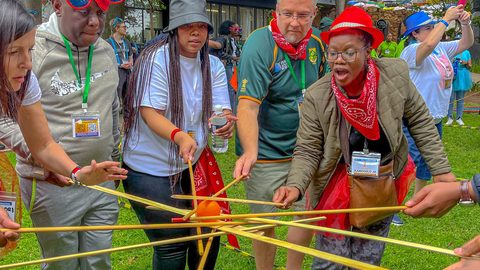
Facilitated and Self-Run Team Building Activities in Singapore Compared
The difference between a facilitated team building session with a debrief and a self-run activity in Singapore, and when the facilitator is worth the cost.
Facilitated vs Self-Run Team Building Singapore: The One Question That Decides Your Event
The real difference between a facilitated team building event and a self-run one in Singapore is not the game. It is the debrief. Every combat game, laser tag, archery tag, bubble soccer, comes with a person who runs safety briefings and game rotation, whether the slot is branded as team building or a corporate fun day. The defining feature of team building as a category is a structured debrief that extracts workplace metaphors from the game. That debrief is what costs extra, and it is the only thing that justifies the additional cost. Without it, you have a play session, not a development intervention.
Facilitated Team Building Debrief Singapore: What You Actually Pay For
When an operator quotes a price for a facilitated team building programme, roughly 30 to 40 percent of that cost covers the facilitator's time after the game ends. The debrief is a structured conversation that lasts 20 to 40 minutes. During it, the facilitator guides the group through what happened: who took leadership in the bubble soccer match, how communication broke down during the archery tag round, whether the team balanced risk correctly in the escape room. This process is called workplace metaphor extraction, and it is the only part of the event that a manager cannot replicate by talking to colleagues over lunch. The facilitator is trained to observe behavioural dynamics surfacing during the game and to surface those observations in a way that translates back to office roles. A group that skips the debrief has done a game. A group that completes it has done team building.
Self-Run Corporate Activity Singapore: What You Gain And What You Assume
Equipment Rental And Session Length
A self-run event in Singapore means you rent equipment, Nerf blasters, archery tag sets, a bubble soccer zorb suit kit, and the operator provides a safety briefing, then leaves. The group manages its own gameplay, game mode adjustment, and team balancing. A typical game round runs 30 to 60 minutes, compared to 1.5 to 3 hours for a facilitated programme that includes the debrief. The smallest group size drops to 2 to 4 pax for some self-run formats, versus 8 to 10 for facilitated ones. The largest group size is capped at 20 to 30 pax per timeslot by venue capacity, whereas a facilitated event can handle 200 or more with multiple facilitators and rotations.
What Drives The Cost Down
The cost driver shifts from number of facilitators and programme duration to equipment rental quantity and venue timeslot. The organiser saves the facilitator cost but assumes every other burden.
Team Building Facilitator Value Singapore: When The Cost Makes Sense
Three Things A Facilitator Delivers
A facilitator's value in Singapore is measured against three specific outcomes that self-run games cannot deliver. First, safety management: the facilitator enforces the lightning alert protocol, monitors Wet Bulb Globe Temperature for heat stress, and calls mandatory water breaks every 20 to 30 minutes when the index exceeds 32°C. Second, engagement pacing: the facilitator adjusts game mode when participant engagement drop-off occurs, rotates teams to prevent dominant players from sidelining others, and manages dart scavenging downtime by staging replenishment. Third, the debrief itself.
Who Should Pay For One
A group of eight to fifteen participants with a clear development objective, improving cross-department communication, surfacing leadership candidates, testing decision-making under pressure, gets value from the facilitator. A group of twenty-five friends who want to shoot each other with foam arrows does not. The facilitator-to-group ratio for active games is 1:10 to 1:15. If the organiser is not willing to assign a staff member to the ratio, the programme is not self-run; it is understaffed.
DIY Team Building Singapore Risk: What The Organiser Accepts
Liability Sits With You
The risk of a self-run event in Singapore is not that the game fails. It is that the organiser becomes the operator without the operator's protections. A commercial operator carries public liability insurance with coverage of S$1 million for adventure activities, this is the industry norm, though not a statutory minimum, and the current rate is the figure to check with the operator's insurer. A self-run organiser relies on the venue's public liability policy, which may not cover activity-related injuries. Participants sign a safety waiver for the equipment, but the waiver does not cover the organiser's own liability if a participant twists an ankle in a bubble soccer zorb suit or suffers a forearm welt from a close-range archery tag shot. Common injury types in bubble soccer are ankle sprains and knee twists caused by the zorb suit restricting lower-leg movement. In archery tag, the most frequent injuries are forearm welts and finger strain. In laser tag, trip-and-fall injuries in low-light arenas are the norm. The organiser who runs a self-run event accepts liability for all of them.
Lightning Stops Everything
Self-run outdoor games also fall under the PUB lightning advisory. Singapore's Meteorological Service operates a Lightning Warning System that requires outdoor events to cease when lightning is within 6 to 8 km. This is not operator discretion; it is a hard stop. A self-run group playing archery tag on a Sunday afternoon in April, the inter-monsoon period with the highest thunderstorm frequency, may have to stop 15 minutes in with no indoor backup. The organiser who booked the slot is the one who explains to the group that the event is over. A commercial operator would have rescheduled to an indoor venue or an alternative date as part of the rain contingency built into the booking.
Self-Run Venue Constraint: Where You Can Actually Play In Singapore
Fixed Arena Vs Mobile Setup
Self-run events in Singapore are constrained by venue access in ways that facilitated programmes are not. A fixed-arena operator has optimised terrain, lighting, and weather independence. A self-run group using a mobile activity operator, a company that brings inflatable cover and equipment to a client-chosen venue, faces surface and space constraints. The function room in a condominium may have a floor that cannot take archery tag mats. The public field may require MCST permission from the management corporation or a booking through NParks. The condo function room also has a noise curfew that ends the programme before the group is ready.
Heritage Sites And Self-Guided Walks
Heritage sites like Fort Canning Park and Labrador Battery are managed by NParks; the land custodian controls access, and the interpretive signage is fixed. A self-guided heritage walk through Kranji War Memorial or Changi Chapel and Museum is free and open during site hours, but the visit format is self-guided indoor museum or open-air memorial, not a curated tour. The gap between visiting a site and understanding what happened there is the difference between a plaque and a guided narrative.
Self-Run Works For Small, High-Trust Groups
A self-run event works when the organiser is willing to be referee, not participant. That means the organiser does not play. The organiser manages the game rotation, enforces safety rules, calls the lightning alert stop, handles equipment provision and dart replenishment, and mediates disputes. A group of four to eight people who know each other well and trust the organiser to be fair can run a successful Nerf session in a condo function room. A group of fifteen colleagues who have never played together cannot. The organiser who joins the game leaves the event with no one managing safety, no one tracking participant engagement drop-off, and no one adjusting game mode when one team dominates. The session degrades into a free-for-all, and the organiser discovers that the operator-provided safety briefing, which lasted five minutes, did not cover how to handle a participant who refuses to call a hit.
When Self-Run Fails: The Most Common Mistake Organisers Make
The single thing that most often goes wrong with a self-run event in Singapore is that the organiser books the wrong group size. The organiser counts total invitees rather than confirmed attendees. An escape room booked for 10 that only fits 8 means two people stand idle or the group is turned away. A Nerf session booked for 20 with 12 blasters means the first round works, the second round stalls when darts are lost under furniture, and the third round never starts because the group spends 15 minutes scavenging darts. The organiser who does not account for the gap between 'blasters provided' and 'sufficient for continuous play' has an event that ends in frustration. The organiser who does not confirm the venue's wet-weather policy during monsoon season has an event that ends in a thunderstorm. The organiser who does not confirm the operator's facilitator-to-group ratio on the day has an event where the facilitator is outnumbered 30 to 1, and safety oversight is the first thing that drops.
Common Questions
What is the minimum group size for a facilitated team building session in Singapore?
The minimum group size is 8 to 10 pax, varying by activity type. Escape rooms require a minimum of 2 to 4 pax but the room itself holds 6 to 10; the 'group size up to 50' claim for escape rooms refers to rotating groups through multiple rooms, meaning half the party waits at any time.
What is the minimum group size for a self-run activity in Singapore?
The minimum group size is 2 to 4 pax, varying by venue. Self-run activities eliminate the facilitator cost but transfer all safety, equipment, and engagement burdens to the organiser.
What is the minimum age for paintball in Singapore?
The minimum age is 14 years, set by the Singapore Police Force licensing condition under the Arms and Explosives Act. Paintball requires a licence; archery tag, laser tag, bubble soccer, and Nerf do not.
Does a self-run outdoor activity stop for lightning in Singapore?
Yes. The PUB lightning advisory and the Meteorological Service Singapore's Lightning Warning System require outdoor activities to cease when lightning is within 6 to 8 km. This is a hard stop, not operator discretion.
What insurance does a facilitated team building operator carry in Singapore?
The industry norm for public liability insurance coverage is S$1 million for adventure activities. This is not a statutory minimum; check the operator's current certificate. The insurer publishes the current coverage limit.
What is the most common injury in bubble soccer?
Ankle sprains and knee twists, caused by the zorb suit restricting lower-leg movement while encouraging full-speed collisions. The suit protects the upper body but leaves lower limbs vulnerable to twisting.
What is the difference between a team building facilitator and a safety marshal?
A safety marshal runs the safety briefing, game rotation, and equipment checks, this is present in all combat games. A team building facilitator does that plus a structured debrief that extracts workplace metaphors from the activity. The debrief is the defining feature of team building as a category.