What Drives the Cost of a Bubble Soccer Session in Singapore: Bubbles, Venue, and Facilitators
Bubble soccer pricing in Singapore is driven by group size, venue choice, facilitator numbers, and session length, with mobile operators and indoor venues each affecting the cost differently.
The Real Cost of Bubble Soccer in Singapore
The question is not whether you can afford bubble soccer in Singapore. It is which of its half-dozen cost drivers applies to your group. Six variables move the final quote: headcount, venue type, facilitator count, session length, day of week, and bubble size. Every one of them shifts the number, and none appears on the operator's home page. A group of ten paying a per-head rate that assumes twenty faces a very different bill than the same ten booking a flat session fee on a weekend. No operator publishes a single number because no two bookings share the same cost structure.
How Headcount Moves the Per-Head Number
The math runs against the first-time booker. Operators carry fixed costs: the truck, the blower, the facilitator's time, the venue hire fee. Spread those across ten players and the per-head rate is high. Spread them across thirty and the rate drops by a third or more. The minimum group size for most Singapore operators is ten players. Below ten, operators will not run the game; the fixed costs eat the margin. Above thirty, the limiting factor becomes the bubble suit count. A standard operator carries enough suits for the group plus one or two spares. A thirty-player booking needs two or three game blocks to give everyone meaningful play time. The price driver is not the number of people. It is the number of people divided by the fixed cost. A group of twelve paying a flat session fee subsidises the venue rental that a group of twenty-four splits more thinly.
Mobile Operators versus Fixed-Arena Operators
Before you compare rates, know which of the two business models you are dealing with. The question "what does it cost" has two different answers. Mobile activity operators bring the bubbles to a venue you choose. They charge a transport and setup surcharge on top of the per-head rate. That surcharge covers the lorry, the blower setup, and the facilitator's travel time. It is why a mobile operator's quote for a public field can look close to a fixed arena's quote for an air-conditioned hall. Fixed-arena operators bundle the venue hire fee into the session price. They do not charge the transport surcharge because the bubbles never leave the building. The trade-off is location. A fixed arena sits in an industrial estate or a sports complex, not at your chosen park. The mobile operator's advantage is that the venue comes to you. The disadvantage is that you inherit the weather risk and the surface quality. A mobile operator on a grass field in a public park is at the mercy of the groundskeeper's schedule and the rain forecast. Neither is under the operator's control.
Facilitator-to-Group Ratio and Its Price Tag
The facilitator ratio is the price driver most groups spot only when they read the quote's fine print. The standard for Singapore operators is one facilitator per ten to fifteen players. That ratio is built into the per-head rate. If you want more facilitators, you pay for them. The cost is not trivial. A facilitator in Singapore earns a session rate that the operator must cover. A group of fifteen with one facilitator gets a game that runs itself after the briefing. A group of thirty with two gets the same. A group of thirty with one gets long waits between turns and a facilitator who cannot watch every collision. The facilitator ratio is a real line item. It is the difference between a booking that feels supervised and one that feels like a shambles. If your group includes novices, children, or people who have never worn a zorb suit, the extra facilitator is not a luxury. It is the difference between a session that ends in an ankle injury and one that ends in laughter. The operator's published ratio is a minimum, not a recommendation. You can always ask for more at a higher price.
Session Duration and the Active-Minutes Gap
When an operator quotes a 60-minute booking, they mean the clock time, not the play time. The first ten minutes go to the safety briefing. It is mandatory and covers rules, safe zones, and emergency stops. The next ten minutes go to suiting up. If you have watched a grown adult struggle into a 9-12 kg TPU bubble, you know ten minutes is optimistic. The final five minutes go to debrief and suit removal. That leaves 35-40 minutes of active play in a 60-minute booking. The per-head rate is calculated on that active time, not the clock. The same gap applies to the 90-minute booking. The briefing and suiting time stays roughly the same. Active play stretches to 60-70 minutes. Groups overpay on duration because they assume the clock runs from the first kick. The operator knows exactly how long the active phase lasts. The rate card reflects that. The 60-minute booking is not 50% cheaper than the 90-minute one. It is closer to 30% cheaper because the fixed costs are identical.
Peak Weekend versus Off-Peak Weekday Rates
The day of the week is a price driver because Singapore's venue-rental market prices for scarcity. A Saturday afternoon in an air-conditioned sports hall is the most sought-after slot. Operators pass on that demand through a peak weekend rate that runs 15-30% higher than the off-peak weekday rate. Check with the operator for the exact spread. A Monday-morning booking is the cheapest. A Friday evening is the most expensive; it is the start of the weekend for most office teams. The gap is not cosmetic. For a group of twenty, a 20% weekend surcharge can be the difference between a workable budget and a blown one. The operator's published rate card shows the weekday rate and the weekend rate. The gap is consistent across the industry because the venue hire fee is the single biggest cost component. If your schedule is flexible, a Tuesday morning booking buys the same active play minutes as a Saturday afternoon at a fraction of the price. The trade-off: weekend slots book out two to three weeks in advance. A last-minute weekend slot is rare.
Venue Hire Costs: Indoor Halls versus Outdoor Fields
Indoor Halls: Climate Control at a Premium
Where the game happens is the single largest cost driver. Singapore's venue-rental market sets the floor. Indoor air-conditioned sports halls command a venue hire fee that runs two to three times the cost of an outdoor public field. The operator passes that through in the per-head rate. The indoor hall costs more, but it is rain-proof and air-conditioned. That premium is the difference between a booking that happens and one that gets postponed.
Outdoor Fields: Cheaper but Weather-Dependent
The outdoor field booking is cheaper. It comes with two structural problems: the heat and the rain. Singapore's National Environment Agency heat stress guidelines recommend scheduling outdoor activity before 11:00 or after 16:00. That pushes the outdoor window into a narrow band the operator may not have available. The rain is the bigger issue. A light drizzle turns the field slippery. A thunderstorm stops play entirely for lightning risk. The wet-weather cancellation policy is a line item in the operator's terms. It offers a full reschedule, not a refund. Check with the operator for the exact window. A group that books an outdoor field during the monsoon season without a backup date is gambling the session fee on the forecast.
Kid-Sized Bubbles and the Surcharge Question
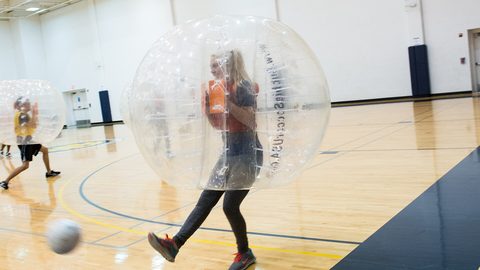
If your group includes anyone under the minimum age of seven, or under the minimum height of 1.2 metres, the operator will not let them into a standard bubble. Confirm the current thresholds with the operator. The standard bubble has a diameter of 1.5 metres and a weight of 9-12 kg. A child below that height cannot see over the rim or move their legs properly. Child-sized bubbles exist, but they are a niche piece of equipment. Most operators do not carry them as standard. When an operator does have them, the kid-sized bubble carries an additional equipment surcharge. The operator has to transport a separate set of suits and maintain them separately. The surcharge is real, and it applies only if the operator has the equipment at all. A group with children under seven or under 1.2 metres should confirm child-sized bubble availability before booking. The alternative is a child who cannot play and a parent who still pays the per-head rate. If the operator does not have child-sized bubbles, the activity is effectively adults-only. The price should reflect that.
The Hidden Costs: GST, Service Charge, and the Fine Print
Every quote in Singapore is subject to GST and service charge. Together they add roughly 17% to the headline number. The operator's rate card shows the before-tax figure. The booking platform adds the tax and the service charge at the point of payment. Check the operator's site for the current rates. The service charge is not optional and it is not a tip. It is the operator's revenue for processing the booking and managing the session. Beyond the tax, the fine print contains the other cost drivers: a minimum group size stated in the terms, a booking lead time of seven to fourteen days for weekend slots, and a wet-weather cancellation policy that allows a reschedule but not a refund. Confirm the lead time with the operator. The operator's business model assumes that a certain percentage of groups will cancel or no-show. The pricing builds in that risk. A group that has read the fine print knows which line items are fixed and which are negotiable. That knowledge is the difference between a surprise bill and a budget that holds.
The Failure Case: When the Normal Route Is Closed
The Walk-In That Does Not Exist
The most common mistake is assuming bubble soccer operates like a casual park game where you can walk up and join. It does not. The walk-in model does not exist because the economics do not work. The minimum group size of ten means the operator cannot run a booking for six at the same per-head rate. The fixed costs of transport, setup, and facilitation mean the operator loses money below that number. Arrive at a fixed-arena operator on a Saturday afternoon without a booking, and the answer is no. The next available slot is a week away.
The Outdoor Gambit and the Duration Trap
The second mistake is booking an outdoor field during the monsoon season without confirming the wet-weather policy. The third is assuming the two-hour booking means two hours of play. The active play time is closer to 60 minutes. If the normal route is closed, the backup is not another bubble soccer provider. It is a different activity entirely.
Alternatives That Match the Intensity
A group that needs the same physical intensity should consider archery tag or laser tag. Both run indoor in air-conditioned spaces and carry the same group-size dynamics without the weather risk. A group that needs the same novelty but has fewer than ten players should look at escape rooms. They run with as few as two players, though the group size maxes out at six to eight per room.
Who Bubble Soccer Actually Suits
Bubble soccer suits corporate team-building organisers who need a high-intensity, low-skill activity that puts everyone on the same physical level. It suits groups of adult friends who want to laugh at each other. It does not suit school groups with children under seven. The minimum age and height rules exclude them. It does not suit anyone who cannot handle the heat or the physical collision. The other key distinction: bubble soccer is a shared-suit activity. You are wearing a zorb that has been worn by dozens of players before you. The hygiene question is a persistent complaint that no operator has fully solved. The suits are wiped down between sessions. They are not washed. The smell is a known issue. For the right group, the novelty outweighs the odour. For the wrong group, the booking turns into a hygiene negotiation. The activity suits groups that want the collision experience, not the ball skill. The bubble makes ball control nearly impossible. The game is about the tackle, not the pass. It is not a replacement for five-a-side football. It is not a sport that rewards practice.
How the Cost Drivers Stack Up
If you are comparing bubble soccer with other group activities in Singapore, the cost structure is what separates it. The per-head rate for bubble soccer is higher than a casual game of five-a-side football. The equipment is more expensive to buy and maintain. The facilitator cost is higher because the operator assumes liability for the collisions. The venue hire fee is comparable to a futsal pitch rental. But the bubble soccer operator bundles the equipment and the facilitation into the rate. Futsal rental is just the pitch. The total cost for a group of twenty for a 90-minute booking is dominated by the facility and the facilitator. The per-head rate drops as the group approaches the maximum; the fixed costs spread more thinly. The comparison with laser tag is different. Laser tag has a higher upfront cost per player because of the electronic equipment. The session can run with a lower facilitator ratio because the game is self-scoring. The comparison with archery tag is the closest. Both are high-intensity, low-skill, and indoor-capable. Both carry a similar per-head rate. The choice between them is a question of whether you want the physical contact of bubble soccer or the ranged combat of archery tag.
The One Fact That Changes the Decision
The single most important fact for any group weighing bubble soccer against its alternatives is the ratio of active play minutes to booked time. A 90-minute bubble soccer booking yields 60-70 minutes of active play. That works out to a per-active-minute cost higher than any other line item. The same 90-minute booking for laser tag yields closer to 75-80 minutes of active play. There is no suiting-up process and the briefing is shorter. The gap is the cost of the bubble itself. It is why the operator can charge a premium. If the group's objective is maximum play for the money, bubble soccer is the wrong choice. If the objective is the specific experience of being in a zorb suit and colliding with other people, the premium is worth paying. The decision is not about which activity is better. It is about which activity fits the group's actual need for the budget they have.
The Fine Print That Changes the Price
The booking platform's terms contain the cost drivers that no rate card shows. The minimum group size is stated as ten players. The operator will not run a session below that. The booking lead time for a weekend slot is seven to fourteen days. Check with the operator for the current window. A last-minute weekend slot is rare. The wet-weather cancellation policy for outdoor bookings offers a reschedule, not a refund. The reschedule must happen within a stated window, typically 90 days. Confirm the window with the operator. The indoor booking has no weather risk. It carries a higher venue hire fee that is passed through in the per-head rate. The operator's terms also specify the maximum group size, typically thirty players. The effective ceiling is where wait-time between turns becomes unacceptable. For a group of thirty, the wait-time is long enough that the session loses momentum. The facilitator will need to run multiple game blocks to give everyone meaningful play time. The operator's rate card shows a per-head rate for the minimum group size and a lower per-head rate for larger groups. The break-even point is around twenty players.
The Bottom Line for the Budget-Conscious Group
The cheapest way to book bubble soccer in Singapore: go as a group of twenty or more on a weekday morning, at an outdoor public field, with a mobile operator that does not charge a transport surcharge for your area, and with the standard facilitator ratio. The most expensive way: book a group of ten for a Saturday afternoon in an indoor air-conditioned hall with a fixed-arena operator, with extra facilitators and child-sized bubbles. The gap between those two scenarios is multiples, not percentage points. It is driven entirely by the cost drivers laid out here. The group that wants to save money should ask the operator for a quote based on the off-peak weekday rate. Confirm that the venue hire fee is the outdoor rate. Verify whether the per-head rate includes the GST and service charge or adds them on top. The group that wants the best experience should pay the indoor premium and book the weekend slot. The air-conditioning and the rain-proofing are worth the difference on a day when the weather turns.
- Standard bubble diameter: 1.5 m
- Standard bubble weight: 9-12 kg
- Bubble material: TPU or PVC
- Typical session duration: 60-90 minutes
- Minimum group size: 10 players
- Typical group size range: 10-30 players
- Minimum age (typical): 7 years
- Minimum height (typical): 1.2 m
- Standard facilitator ratio: 1 per 10-15 players
- Weekend vs weekday premium: 15-30% higher
- Typical booking lead time: 7-14 days
Who Should Skip Bubble Soccer Entirely
Bubble soccer is not for everyone. Anyone who is not comfortable with physical contact, anyone who has a knee or ankle injury, and anyone who is pregnant should not book this activity. The zorb suit restricts lower-leg movement while encouraging full-speed collisions. That combination is a genuine injury risk. The most common injuries are ankle and knee sprains. They happen when a player falls awkwardly under contact. The activity is also not suitable for anyone who cannot handle the heat, even in the indoor halls. The suit is not breathable. Sweat builds up quickly. The hygiene question is the other dealbreaker for some players. The suits are shared. They are not washed between sessions. The smell is a real issue. If any of these descriptions fits you, choose a different activity. The alternatives are better for you, and the money will go further.
The Final Consideration: What Are You Actually Paying For?
When you strip away the rate cards and the terms, the bubble soccer price drivers in Singapore come down to this. You are paying for the novelty of wearing a 9-12 kg inflatable suit and the supervision that keeps you from injuring yourself while you do it. The venue cost, the facilitator cost, and the equipment cost are all in service of that single experience. The per-head rate you see on the operator's website is the sum of those three costs plus a margin. The margin is the operator's profit. Understanding that structure tells you where the negotiation room is. The venue cost is fixed. The equipment cost is fixed. The facilitator cost is semi-fixed. The only real lever you have is the group size. That is why the per-head rate drops as the group grows. A group of twenty is the sweet spot where the fixed costs spread enough to make the rate acceptable. A group of ten is the minimum viable size where the operator breaks even. The group that knows this is the group that gets the best deal.