Group Kayaking, High Ropes, Cycling and Hiking in Singapore
How kayaking, high ropes, cycling, and hiking work as group activities in Singapore—session flow, fitness requirements, safety rules, and what changes with group size.
How Kayaking, High Ropes, Cycling, and Hiking Compare For Groups In Singapore
The single most useful fact for any group weighing these four activities is the weather hard stop. PUB lightning advisory rules require all four to cease the moment lightning is within 6-8 km. That is not operator discretion. It applies whether you are in a mangrove kayak, on a high ropes element, riding a park connector, or hiking Bukit Timah hill. The northeast monsoon (December, March) and southwest monsoon (June, September) bring predictable heavy rain. Start your planning with a wet-weather backup, not with the activity itself.
Each format handles groups differently on fitness requirements, safety gear, and how the experience scales from 10 to 30 people. The table below shows the comparison at a glance. The sections that follow explain why each number matters and what goes wrong when you ignore it.
| Activity | Minimum Age | Fitness Level | Safety Gear | 10 Pax Experience | 30 Pax Experience | Weather Trigger | Cost Driver |
|---|---|---|---|---|---|---|---|
| Kayaking | 7 (double with adult); 13 (single) | Low to moderate; paddling endurance | PFD (ISO 12402), sun protection | 1 guide per 8–12; tight group, fast pace | 3–4 guides; staggered launch, wait time at landing | Lightning within 6 km, wind over 20 knots | Group size thresholds at 10, 20, 30 pax |
| High Ropes | 5 (junior, 110 cm); 10 (standard, 140 cm) | Moderate; upper body and balance | Full-body harness (EN 361), helmet (EN 12492), twin lanyard | 1 facilitator per 8–12; quick rotation through 2–3 levels | 3–4 facilitators; 30 pax means 45–60 min wait between circuits | Lightning within 8 km, wind over 40 km/h | Facilitator ratio (1:8 standard; 1:5 for youth adds cost) |
| Cycling | 10 (off-road); 13 (on-road) | Moderate to high; leg endurance | Helmet (EN 1078), front and rear lights after 18:00 | 1 guide per 10–15; compact route, single-file on roads | 3 guides; group must split under LTA rules (max 5 abreast on roads) | Heavy rain under 150 m visibility, lightning within 6 km | Bike type (city bike included; MTB, road, e-bike add cost) |
| Hiking | 5 (nature trail); 7 (MacRitchie TreeTop Walk) | Low to moderate; walking endurance | Covered footwear, 1 litre water per 2 h | 1 guide per 15–20; conversational pace | 2 guides; group of 30+ requires NParks permit | Lightning within 6 km (Treetop Walk closes) | Guide accreditation (STB-licensed nature guide adds cost) |
Group Kayaking Singapore: Mangrove Vs Open-Water Routes
Route Choice And Physical Demand
Group kayaking sessions run 2-4 hours including safety briefing, gear fitting, on-water instruction, a guided paddle, and debrief. The common format uses one instructor per 8-12 participants. That ratio is the binding constraint on how many people you can put on the water at once. A group of 10 needs one instructor. A group of 30 needs three or four, and the launch becomes staggered. The last kayak leaves the beach 15-20 minutes after the first.
Route choice determines the physical demand. Mangrove routes, such as those at Pulau Ubin or the Sungei Buloh Wetland Reserve, are sheltered, tidal, and require paddling through narrow channels with overhanging vegetation. The pace is slow. The current does the work on the flood tide. The primary risk is abrasions from branches, not capsizing. Open-water routes, such as East Coast Park or Sentosa's coastline, expose the group to wind, boat wakes, and sun. A single kayak requires a minimum age of 13 with adult supervision on the water; a double kayak with an adult can carry a child aged 7. The fitness requirement is low to moderate. You need paddling endurance for 1.5-2 hours of active paddling, not sprint speed.
Safety Gear, Weather Triggers, And Heat Rules
Required safety gear is a PFD certified to ISO 12402 or equivalent. The provider's licence comes from the Singapore Tourism Board adventure licence framework, and the governing safety standard is SS 634:2017. Weather cancellation triggers are lightning risk within 6 km, heavy rain reducing visibility below 200 m, or wind exceeding 20 knots. The heat management rule, applied by licensed providers, is a compulsory water break every 30 minutes when WBGT reaches 32 °C. Common injuries are minor abrasions, sunburn, dehydration, and shoulder strain.
What Drives The Cost Up
Cost drivers are group size thresholds at 10, 20, and 30 pax, where per-head price drops; weekday rates 15-25% lower than weekend; whether the base price includes a sit-on-top kayak or a touring kayak adds cost; and whether the guide holds a Singapore Canoe Federation Level 2 coach certification, which adds a premium. The failure case is booking an open-water route during the northeast monsoon and having the session cancelled by wind. Kayaking has no indoor backup.
High Ropes Course Group Singapore: The Belay System And Facilitator Ratio
How The Circuit Runs
High ropes course sessions run 1.5-3 hours including harness fitting, ground-school briefing, 2-3 circuit levels, and debrief. The common format is a rotational circuit with one facilitator per 8-12 participants on the course. That facilitator-to-group ratio is the binding constraint, not the number of elements. A group of 15 with one facilitator means participants spend 10-15 minutes waiting on the platform for their turn on each element. A group of 30 with three facilitators keeps wait times under 5 minutes.
Gear, Standards, And Age Limits
The required safety gear is a full-body harness meeting EN 361 or UIAA 105, a helmet meeting EN 12492, and a twin lanyard system with auto-locking carabiners. The belay system is continuous. The participant is always attached to a safety line, never disconnected between elements. The junior course requires a minimum age of 5 and a height of at least 110 cm; the standard course requires 10 years and 140 cm. The maximum weight limit is 120 kg, but this varies by course. Confirm it with the provider.
The governing safety standard is SS 588:2013, and accreditation comes from ACCT or ERCA vendor certification. Weather suspension triggers are a lightning alert within 8 km, sustained wind above 40 km/h, or heavy rain making platforms slippery. The heat management rule, applying MOM outdoor work guidelines, suspends activity when WBGT reaches 33 °C. Common injuries are minor friction burns, bruising from harness pressure, and blisters.
Cost And The Common Failure
Cost drivers are the number of circuit levels (2-level vs 3-level vs full course); group size thresholds at 15, 25, and 40 pax; the facilitator-to-participant ratio (1:8 standard; 1:5 for youth or corporate facilitation adds cost); and venue type (purpose-built outdoor park vs indoor clip-and-climb facility). The failure case is booking a 30-pax group with a single facilitator. That produces long wait times and lax safety oversight, because the facilitator cannot monitor every participant on a large course simultaneously.
Group Cycling Route Singapore: Road, Trail, And Self-Guided Vs Facilitated
Session Format And The Law On Group Size
Group cycling sessions run 2-5 hours including bike fitting, safety briefing, guided ride with rest stops, and return. The common format is a guided trail or park-connector ride with one guide per 10-15 riders. Required safety gear is a helmet meeting EN 1078 or CPSC standard, plus a front white light and rear red light if riding after 18:00. The on-road guided group ride requires a minimum age of 13 under LTA advisory; under 13 must use cycling paths or park connectors only. Off-road trail rides require a minimum age of 10, provider-dependent.
The legal requirement most groups miss is the LTA Road Traffic Act rule. Group size on public roads is capped at 5 cyclists in single file if riding abreast. Larger groups must split. A group of 30 riding from East Coast Park to Marina Bay must ride in six sub-groups of 5, each with its own guide or designated leader, or they are breaking the law. On park connectors, the limit does not apply, but path width and pedestrian traffic make groups of more than 15 unwieldy.
Route Types And Fitness
Route options split between park connectors (paved, flat, shared with pedestrians) and mountain biking trails (unpaved, technical, at locations such as Bukit Timah or Tampines Bike Park). A park-connector ride demands low to moderate fitness: 2 hours of steady pedalling with rest stops. A mountain biking trail requires moderate to high leg endurance and basic bike-handling skill.
Self-Guided Vs Facilitated, Weather, And Cost
The self-guided versus facilitated distinction matters for cost and safety. A self-guided ride means the provider supplies bikes, helmets, and a route map, but no guide. The group navigates itself, handles mechanical issues, and manages road safety. A facilitated ride includes a guide who leads the route, carries a first-aid kit, and coordinates with a support vehicle. The support vehicle, called a sag wagon, adds cost but is essential for groups with mixed fitness levels because it collects riders who cannot finish the route.
The weather cancellation trigger is heavy rain reducing visibility below 150 m or lightning risk within 6 km. The heat management rule is a compulsory water stop every 45 minutes when WBGT reaches 32 °C. Common injuries are abrasions, wrist fractures from falls, knee strain, and heat exhaustion. Cost drivers are bike type (city bike included in base price; mountain bike, road bike, or e-bike adds cost), route length and duration (half-day vs full-day), support vehicle inclusion, and group size thresholds at 10, 20, and 30 pax. The failure case is a self-guided group of 20 attempting a mountain biking trail without a guide or support vehicle. A single mechanical failure or injury halts the entire ride.
Group Hiking Trail Singapore: Routes, Permits, And The TreeTop Walk
Session Format And The Two Main Routes
Group hiking sessions run 2-6 hours including route briefing, guided walk with interpretive stops, rest breaks, and end-point transport. The common format is a guided nature trail or park route with one guide per 15-20 participants. Required safety gear is covered footwear with tread and at least 1 litre of water per person per 2 hours. A guided nature trail requires a minimum age of 5, provider-dependent. For the MacRitchie TreeTop Walk route, the minimum age is 7 under NParks advisory due to the trail length and steps.
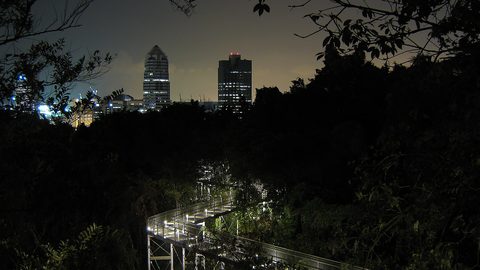
The route most groups choose is the MacRitchie reservoir loop, which combines a boardwalk, the TreeTop Walk suspension bridge, and forest trail. The TreeTop Walk is a suspension bridge 25 metres above the forest floor, and it is one-way with a capacity limit. NParks closes the bridge when lightning is within 6 km. Groups of 30 or more must book a time slot. The alternative is the Bukit Timah hill route, which is shorter but steeper, with a sharp elevation gain over 1.2 km. The fitness requirement for MacRitchie is low to moderate: 4-5 km of walking with stairs. Bukit Timah is moderate to high: steep climbs on uneven terrain.
The Permit You Must Not Miss
The requirement most organisers miss is the NParks permit for organised activity in nature reserves. Groups of 30 or more participants require this permit, applied for at least 2 weeks in advance. The fee is revised annually by NParks; check the NParks website for the current figure. Without the permit, the group can be turned away at the trailhead.
Guided Vs Self-Guided, Weather, And The Failure Case
The self-guided versus facilitated distinction matters for interpretation. A self-guided group follows a map and reads signage; the experience is exercise, not education. A facilitated hike with an STB-licensed nature guide adds cost but transforms the walk. The guide explains the secondary forest regeneration, the history of the reservoir, and the wildlife (long-tailed macaques, monitor lizards, and the occasional python). Cost drivers are route type (free-access park connector vs ticketed reserve trail with a compulsory guide), guide accreditation, transport inclusion (end-point pickup vehicle adds cost), and group size thresholds at 15, 30, and 50 pax.
Common injuries are ankle sprains from uneven trail surfaces, blisters from improper footwear, heat exhaustion, and insect bites. The weather suspension trigger is the same lightning risk within 6 km that closes the TreeTop Walk. The heat management rule shortens or reroutes the walk to shaded paths when WBGT reaches 33 °C. The failure case is a group of 35 arriving at MacRitchie on a Saturday morning without a permit, expecting to walk the TreeTop Walk, and being turned away because the bridge is at capacity and the group exceeds the unpermitted limit.
Group Planning: Advance Booking, Wet-Weather Backup, And The Hard Stop
Booking Windows And Group Tiers
Book a standard group at least 2 weeks ahead. For peak periods of June, November, and December, allow 4 weeks. The peak demand months for outdoor activities in Singapore are June, November, and December, which coincide with school holidays. The wet season months with the highest rain-cancellation risk are November, December, and January, based on NEA northeast monsoon data.
Group size tiers for per-head pricing are 10-15 pax for small, 16-30 for medium, 31-50 for large, and 51+ for custom. Providers must hold public liability insurance; check the current figure with the provider. All participants must sign a liability waiver; under 18 requires a parent or guardian signature. Participants must declare pre-existing conditions such as asthma, heart conditions, and recent injuries before the session.
Wet-Weather Backup And Who Decides
Wet-weather backup options vary by provider. Most offer an indoor alternative or reschedule at no charge if the provider cancels due to weather. If the client cancels due to weather but the provider deems conditions safe, a cancellation fee applies. This is the detail most groups miss: the provider, not the group, decides whether conditions are safe. The PUB lightning advisory is a hard stop that applies to all four activities. No provider will override it. The monsoon seasons mean outdoor activity planning must account for wet-weather alternatives year-round, not just during the rainy months.
Common Questions
What is the minimum age for kayaking in a group in Singapore?
The minimum age for a single kayak is 13 years with adult supervision on the water. A double kayak with an adult can carry a child aged 7 years. The minimum age for a high ropes junior course is 5 years with a height minimum of 110 cm; the standard course requires 10 years and 140 cm. For cycling, the minimum age for an off-road trail ride is 10 years, provider-dependent; on-road guided group rides require 13 years. For hiking, the minimum age for a guided nature trail is 5 years, and 7 years for the MacRitchie TreeTop Walk route.
What safety gear is mandatory for group high ropes courses in Singapore?
Required safety gear for high ropes courses includes a full-body harness meeting EN 361 or UIAA 105, a helmet meeting EN 12492, and a twin lanyard system with auto-locking carabiners. The governing safety standard is SS 588:2013, and accreditation comes from ACCT or ERCA vendor certification. For kayaking, the required gear is a PFD certified to ISO 12402 or equivalent. For cycling, a helmet meeting EN 1078 or CPSC standard is required, plus front and rear lights if riding after 18:00. For hiking, covered footwear with tread and 1 litre of water per person per 2 hours are required.
How does a group of 30 people experience a high ropes course compared to a group of 10?
A group of 10 with one facilitator experiences quick rotation through 2-3 circuit levels, with wait times under 5 minutes between elements. A group of 30 requires three or four facilitators; with one facilitator, wait times on the platform can reach 45-60 minutes between circuits. The facilitator-to-group ratio of 1:8 for standard courses and 1:5 for youth or corporate facilitation is the binding constraint. For kayaking, a group of 30 requires 3-4 guides and a staggered launch. For cycling, a group of 30 must split into sub-groups of 5 under LTA road rules. For hiking, a group of 30 requires an NParks permit.
What weather conditions cancel outdoor group activities in Singapore?
The PUB lightning advisory is the hard stop for all four activities. Kayaking is cancelled when lightning is within 6 km, heavy rain reduces visibility below 200 m, or wind exceeds 20 knots. High ropes is cancelled when lightning is within 8 km, sustained wind exceeds 40 km/h, or heavy rain makes platforms slippery. Cycling is cancelled when heavy rain reduces visibility below 150 m or lightning is within 6 km. Hiking is cancelled when lightning is within 6 km, and NParks closes the MacRitchie TreeTop Walk under the same trigger. The heat management rules also apply: compulsory water breaks every 30 minutes for kayaking when WBGT reaches 32 °C, and activity suspension for high ropes and hiking when WBGT reaches 33 °C.
Do I need a permit for a group hike in Singapore's nature reserves?
Yes. Groups of 30 or more participants require an NParks permit for organised activity in nature reserves. The fee is revised annually by NParks; check the NParks website for the current figure. The permit must be applied for at least 2 weeks in advance. Without it, the group can be turned away at the trailhead. The permit requirement applies only to hiking in nature reserves; kayaking, high ropes, and cycling at commercial venues do not require a separate NParks permit, but the provider handles any relevant permits.