Managing Heat and Hydration During Bubble Soccer Sessions in Singapore
Bubble soccer in Singapore's heat and humidity risks heat exhaustion inside the insulating zorb suit. Hydration breaks, indoor venues, and shorter active play periods reduce the danger.
The Heat Problem Bubble Soccer Heat Hydration Singapore
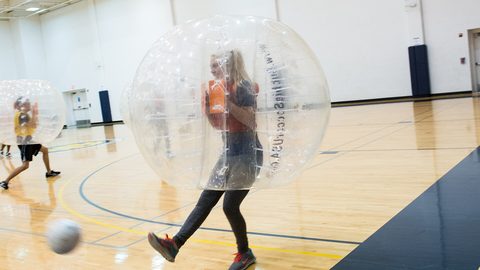
Most first-timers assume a bubble soccer booking is just football with inflatable suits, and that the afternoon slot they picked will proceed as planned. In Singapore, the real opponent is not the other team. It is the combination of 30°C-plus air and humidity that sits above 80 percent. The zorb suit, the entire point of the game, is also a wearable greenhouse. It traps body heat and stops sweat from evaporating, which is how your core temperature climbs. Bubble soccer heat hydration Singapore is not a marketing phrase; it is the operating condition for every outdoor booking between 10:00 and 16:00. A slot that starts at 3 p.m. on a dry July day will still cook you inside the suit, because the suit adds up to 10°C to the apparent temperature you feel. Plan for the heat before you plan for the football.
What Actually Happens to Your Body Inside the Suit
The zorb suit insulation works against you. It is a sealed air layer that your body has to heat up before you feel anything, and on a typical afternoon the interior of the suit can run 10°C hotter than the air outside it within ten minutes of active play. You will sweat, but the suit stops the sweat from evaporating, which is the only cooling mechanism your body has. The result is a rapid rise in body temperature, a rise in heart rate, and a faster drain on your fluids than you would get playing the same game without the suit. This is why the Sport Singapore heat advisory guidelines exist, and why the wet-bulb globe temperature reading matters more than the thermometer in the shade. The WBGT accounts for humidity, wind, and sun, and it is the number operators should be checking. Ask what the provider does when the WBGT crosses 31°C; the national advisory says reduce outdoor exertion and rest 15 minutes per hour. Above 33°C, outdoor physical activity should be cancelled or postponed. Do not assume the crew knows this. Ask.
The One Number That Decides Everything: Active Play Minutes
Here is the fact that changes how you should read every listing for bubble soccer in Singapore. The advertised two-hour slot is a lie, in the sense that it is not a lie anyone is telling you. The clock includes a briefing, suiting up, the safety talk, and a debrief. Actual active play is 45 to 60 minutes, split into halves of five to seven minutes each, with three- to five-minute rests between halves. That means you are in the suit for 20 to 28 minutes of running and colliding, not for the full stretch. That is not a rip-off; it is a safety feature. It is also the number you need to manage your expectations. If you have booked a two-hour slot, you are paying for the venue, the facilitator, and the equipment, not for two hours of exercise. If you want more play, book a longer booking and ask the crew how many extra halves that includes. The standard package is two to four halves. Four halves is a serious workout in that heat.
- Typical session duration (booked): 60-90 minutes including briefing, kitting up, play, debrief
- Typical active play time: 10-28 minutes (match halves of 5-7 min, 2-4 halves)
- Rest interval between halves: 3-5 minutes
- Recommended water intake before session: 500 ml, 2 hours prior
- Recommended water intake during session: 150-200 ml every 15-20 minutes
- Zorb internal temperature rise: Up to 10°C above ambient within 10 minutes of play (outdoor)
- Outdoor heat index, 10:00-16:00: 35-42°C on artificial turf
Hydration Break Frequency: The Question You Must Ask
Every provider in Singapore will tell you they supply water and schedule breaks. The question is how often, and the answer is not uniform. Bubble soccer hydration break Singapore is a matter of company policy, not regulation. Some run a 5-minute water break after every half, which is the sensible minimum. Others, especially those running indoor air-conditioned venues, may extend to 10 minutes between halves because the players need it. The Sport Singapore guideline is specific: drink 150 to 200 ml every 15 to 20 minutes of activity. That is a hard number to hit during a 5-minute half, which is why the break between halves is where the drinking happens. If the crew cannot tell you the break schedule before you book, treat it as a red flag. You should also confirm that water is provided and cold, not just available for purchase. For bookings exceeding 60 minutes of total activity, which most are not, the recommendation is an isotonic sports drink at 500 to 1000 ml per hour to replace electrolytes. In practice, for a standard slot, plain water is fine, but you should eat something salty beforehand if the booking is in the afternoon.
Outdoor Sun Exposure vs Indoor Ventilation: Neither Is Air-Conditioned
Choosing Your Venue Type
Choose your venue type and the heat profile changes, but it does not disappear. Bubble soccer outdoor heat safety Singapore is the harder problem: direct solar radiation on artificial turf adds 5 to 10°C to the apparent temperature, and the UV index in Singapore hits 10 to 13, which is in the extreme range. A 3 p.m. kickoff on a dry grass field will cook you. The indoor option is not automatically safe either. Most indoor bubble soccer venues use synthetic sports flooring or artificial turf inside a warehouse-style hall with large doors open for ventilation. That is not air-conditioning; that is a fan blowing hot air around. True air-conditioned venues exist, but they are rarer and cost more. If the listing says "indoor," ask specifically whether the space is air-conditioned. A room that is 28°C with fans is better than the 35°C sun, but it is not a cool retreat.
The Monsoon Factor
The monsoon season heat is a different animal: from November to January, the rain brings humidity that stays above 85 percent even when the temperature drops to 27°C. You will be drenched in sweat before you touch the ball.
Recognising Heat Exhaustion: The Facilitator's Job and Yours
Symptoms of heat exhaustion in bubble soccer are easy to miss if you are not looking. The earliest signs are dizziness, nausea, and disorientation. A player who is unsteady on their feet, or who cannot remember the drill they just learned, or who says the world is spinning, is not being funny. They are moments away from heat exhaustion. The zorb suit hides the early signs too, because you cannot see a player's face well and the suit muffles their voice. This is why the facilitator-to-group ratio matters, and why you should not accept a ratio worse than 1:15 for a full-contact game. The facilitator is the one who says the safety stop. You, as a player, have the right to stop the game yourself. If you feel dizzy, nauseous, or confused, sit down, take the suit off, and get into the shade or the air-conditioned lobby. Do not "push through" for the last half. The booking is not a test of endurance; it is a game that costs money and is not worth a trip to the A&E for heat stroke.
What to Do When the Weather Turns: The Lightning Rule
Singapore's weather can cancel a booking with less than an hour's notice, and the reason is not rain; it is lightning. The PUB lightning advisory is a hard stop: outdoor activities cease when lightning is within 6 to 8 kilometres of the venue. That is not operator discretion; it is a national safety guideline. When the sky goes dark and the wind picks up, the crew should call the session or move you indoors.
Rain Policies and Rescheduling
Ask about the rain policy before you book. Light rain is fine to play in, and many crews will keep going. Heavy rain or lightning means a suspension, and the question is whether the provider offers a rain check or a reschedule. If the answer is no, and you are booking during the November-to-January monsoon, you are gambling with your money. The dry season, June to August, still has sudden storms, but they are shorter.
Timing Your Booking
If you are flexible, book a morning slot before 10 a.m. when the surface is cooler and the storm risk is lower. If you are not flexible, book an indoor venue with a solid rescheduling policy.
Who Should Skip Bubble Soccer Altogether
Not everyone should play bubble soccer in Singapore's heat, and knowing who should skip it is part of the job. Anyone with a history of heat stroke, heart conditions, or high blood pressure should not play, full stop, and no waiver will protect you if you do not tell the crew. Pregnant women and anyone with a recent knee or ankle injury should skip it too, because the zorb suit restricts lower-leg movement and makes twisting injuries more likely. If you are over 50 and not used to high-intensity exercise, this is not the activity to start with. The suits are heavy, the collisions are real, and the heat is unforgiving. There is no shame in choosing the spectator role and staying in the air-conditioned lounge with a cold drink. The game is fun because it is physical; it is not fun if you are the one who collapses. If you decide to play, hydrate before, during, and after, and know your limits.
The Monsoon Season Heat: When the Rain Does Not Cool Things Down
The November-to-January monsoon is the low season for bubble soccer, and not just because of rain. The Northeast Monsoon brings high humidity that makes the air feel thicker, and the heat stays high. A rainy day in December can still hit 29°C with 90 percent humidity, which is a heat index above 35°C. The rain itself is a problem because it soaks the field, and playing on a wet surface with an inflatable suit is a recipe for a twisted ankle. Crews know this and will cancel or move you indoors. If you book during this period, confirm the monsoon season heat policy in advance and get it in writing. The dry season, June to August, is better for outdoor play, but the heat is more intense, with daily highs near 32°C. There is no perfect time; there is only the right preparation. That preparation is the same: book early morning or late evening, hydrate before you arrive, and ask about the provider's heat and rain policies before you hand over your money.
A Note on Costs and Value: What You Are Paying For
A two-hour bubble soccer booking in Singapore costs between SGD 25 and SGD 45 per person, depending on the venue and the package. The outdoor field is cheaper; the air-conditioned indoor venue is at the top of the range. You are paying for the equipment, the facilitator, the venue, and your share of the water. What you are not paying for is a full two hours of play; you are paying for the slot. A well-paced 60-minute booking with 25 minutes of active play is better value than a 90-minute one with the same active play stretched out by a long briefing and a slow rotation. Ask the crew how many games you will get. If the answer is two, and the slot is 90 minutes, that is a lot of standing around. Four games in 60 minutes is a tighter, more fun experience. The price difference between the two is small. Choose the provider who gives you the most active play per dollar, not the one with the longest listed duration.
The Final Word on Zorb Suit Overheating: A Real Number to Remember
Zorb suit overheating Singapore is the failure mode that ends sessions early. The research is clear: the internal temperature of the suit can rise 10°C above ambient within 10 minutes of play. On a 31°C day, that is a 41°C microclimate around your body. The suit is not designed for long continuous wear, and the recommended maximum continuous time inside is 5 minutes before rotation. That is why the match structure exists: five- to seven-minute halves with a break in between. If you are playing a half and the facilitator does not call a water break at the end, say something. The heat is not a personal failure; it is physics. The zorb suit is a thick layer of PVC that holds in heat and humidity. It is your job to manage it, and the crew's job to make it safe. Now that you know the numbers, you can ask the right questions and enjoy the game without ending up in the clinic.