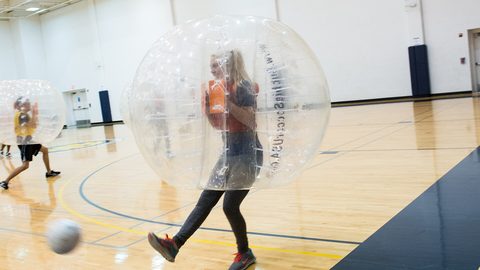
Bubble Soccer Game Formats Beyond Standard Football: Variants Played in Singapore
Bubble soccer in Singapore goes beyond football: last-man-standing, sumo ring-outs, relay races, and team deathmatch. Each format changes pitch size, round duration, and objective.
The Bump That Ends the Game
The zorb suit is on, your face is hot, and the referee shouts the count. Somewhere to your left, a player is flat on their back, arms and legs waving like an overturned beetle. The round does not stop for them. What you booked as bubble soccer in Singapore has just become bubble last man standing. The only score that matters is who is still upright when the clock hits zero.
Why Standard Football Is Not the Whole Menu
Walk into a booking page for bubble soccer in Singapore and the default assumption is 5-a-side football in zorb suits. That is the game mode advertised first, and for good reason: it is the easiest pitch to sell to a corporate team that has played something like it before. But the same crew who rents you the inflatable suits usually runs several other formats, and the standard football is often the one the group abandons halfway through once they realise how hard it is to run, let alone score, inside a giant inflatable shell.
The pitch size stays small. The round duration stays short. The player count per round stays around ten, split into two teams. What changes with the variants is the objective. In standard football, the objective is a goal. In every other format, the objective is usually to knock someone over, control a patch of ground, or simply be the last person standing. That shift in scoring system changes the energy of the outing more than any rule tweak. It removes the illusion that ball skill matters and replaces it with the thing the zorb suit is actually for: full-body collisions.
Bubble Soccer Game Formats Singapore
Fixed Menus Versus Custom Rotations
When you search for bubble soccer game formats Singapore, the results split into two buckets: crews who list a fixed menu of games on their website, and crews who mention a custom game option in their FAQ. The first bucket is easier to compare. The second bucket is where the outing actually gets good, because the referee can adapt the format to your group size and fitness level on the spot.
The standard menu across Singapore includes the football match, a sumo-style ring-out game, a relay race, and some version of free-for-all elimination. The order in which you play them matters. A well-run outing starts with the football format while everyone is still sober and coordinated. It moves to the relay race to introduce the running-and-falling rhythm. It ends with last man standing when the group is tired enough to find falling over funny rather than frustrating. A poorly run outing does the reverse, and the last twenty minutes become a safety briefing in practice.
Book for the format variety, not the football. The groups who leave happiest are the ones who asked which game modes the crew runs beyond the default. That question signals to the referee that you want the outing to move, and they will build the rotation around that expectation.
Bubble Soccer Last Man Standing Singapore
Bubble soccer last man standing Singapore is the format that looks simplest and is actually the most demanding on safety planning. The rules are minimal: every player for themselves, no teams. The last player standing who has not been knocked over, pinned, or rolled out of the designated playing area wins the round. Elimination is active. Once you are down, you leave the pitch and wait for the next round.
What changes from standard football is the pitch size, which shrinks dramatically to make contact more likely. The round duration drops to sixty or ninety seconds. A single round of full-contact pushing inside a zorb suit is exhausting. The player count per round stays around ten, but the scoring system is binary: you are either upright or you are out. No referee debates whether a shoulder touched the ground first. A fall is the end of your round.
The failure case to plan for is the person in your group who does not want to be touched. Last man standing is the wrong format for them. A good crew will ask before the outing which participants are uncomfortable with contact. If they do not ask, you should tell them. The alternative is a participant who spends the entire round backing away, which breaks the competitive integrity for everyone else and is no fun for them either.
Bubble Soccer Sumo Format Singapore
Bubble soccer sumo format Singapore takes the free-for-all of last man standing and adds a boundary. Two players enter a marked circle, usually the centre circle of the football pitch or a painted ring on the turf. The objective is to push the other player out of the ring or knock them over. The first to leave the circle, or to touch the ground with any body part outside the zorb, loses the point.
The round duration is shorter than the football format by a wide margin, often thirty to forty-five seconds per pairing. A sumo-style contest inside a zorb suit is mostly a test of leg strength and low centre of gravity rather than endurance. The pitch size is irrelevant because the entire game happens inside the ring. That frees up the rest of the playing area for a parallel group running a relay race or a warm-up drill. It is the scheduling trick crews use to keep a large corporate group moving without dead time.
What makes the sumo format different from the rest of the menu is the player count per round, which drops to two. A group of twenty participants cycles through ten individual contests before anyone gets a second go. The referee has to run this format in parallel with something else or the flow stalls. Ask the crew how they handle that rotation before you book a group larger than fifteen.
Bubble Soccer Relay Race Singapore
Bubble soccer relay race Singapore is the format that looks least like bubble soccer and most like a school sports day. That is exactly why corporate team-building organisers love it. The teams line up at opposite ends of the pitch. One player at a time runs, waddles, or rolls from one end to the other while wearing the zorb suit, then tags the next player in line. The first team to move every player across the pitch wins the round.
The pitch size is the main variable. Some crews run the relay the length of the football pitch, which suits a larger group and a longer round duration of around five minutes per heat. Others run it across the width, cutting the distance in half and doubling the number of heats you can fit in the same outing. The scoring system is the stopwatch. The referee's job is to enforce that a player has actually crossed the line before the next one starts. In the heat of a relay, the competitive instinct to shave a metre off the course is overwhelming.
The relay changes the physical demand on the group. Standard football in zorb suits is short bursts of sprinting and shoving. The relay is sustained, low-speed jogging in a suit that has no ventilation. It is the format most likely to trigger heat exhaustion on an outdoor pitch in the middle of the day. Book the relay for late afternoon or under cover. Check that the crew provides water breaks between heats. That is not a courtesy; it is a safety requirement.
Team Deathmatch and the Custom Game Menu
Beyond the named formats, most crews in Singapore offer a bubble soccer team deathmatch variant that blends the sides. Two teams compete on a pitch the size of a standard football half. The objective is to eliminate the opposing team by knocking players over. Once a player is down, they are out for the round. The round ends when one team is entirely on the ground. The round duration is short, often under three minutes. The rotation cycles teams through multiple rounds so everyone gets a turn in the middle.
This is also the format where crews start to talk about a custom game. A bespoke outing might combine elements of the sumo ring with the relay race, or add a capture-the-flag objective where a player has to carry a foam pool noodle across the pitch while their teammates protect them. The scoring system for these custom games is whatever the referee decides on the day. The cost driver shifts from the per-head price to the referee-to-participant ratio, because a custom game needs more referees to keep it structured.
If you want a specific game mode that you have seen on a competitor's website, name it when you book. The crew's menu is not a fixed list. Most referees are happy to adapt a format they already know to a slightly different objective. What you cannot do is show up on the day, without a reservation, and expect a curated menu of game formats in Singapore. The walk-in model does not work economically, and the outing you want is the one that requires a reservation, a participant count, and a weather backup plan.
What the Referee Is Actually Doing
Every bubble soccer outing in Singapore starts with a referee-led safety briefing, and the briefing is not a formality. It covers the safe zones around the pitch, the rules for making contact, and the emergency stop signal. That signal is usually a raised hand or a shout that stops all play until the referee is satisfied no one is injured. The briefing takes ten to fifteen minutes, and it counts towards your booked duration. A 60-minute booking gives you closer to 45 minutes of active play.
The referee also makes the call on which game modes your group can handle on the day. A group of twenty-something athletes will get told one thing. A group of office workers who have not exercised since the last team-building event will get an adapted format with shorter rounds and more walking. That is not a sales pitch. It is the difference between an outing that ends with everyone laughing and one that ends with someone limping off the pitch. Ask the crew how many participants each referee supervises when you book. Treat a ratio of more than fifteen players per referee as a warning sign.
- Minimum group size: 8 participants
- Maximum group size: 40 participants per outing; check with the operator as venue capacity varies
- Typical outing duration: 60 to 90 minutes, including briefing and suit-up
- Standard team size for football format: 5 vs 5
- Minimum age: 7 years (check with the operator, as it varies)
- Minimum height: 1.2 m (check with the operator, as it varies)
Booking the Outing That Will Not Fall Apart
Timing and Weather
Book your bubble soccer outing in Singapore two to three weeks ahead for a weekend slot. Confirm the crew's wet-weather policy before you pay a deposit. Outdoor pitches are at the mercy of the monsoon. A rain cancellation with no backup plan is the most common way a well-organised event becomes a group of people standing under a shelter checking their phones. Many crews are mobile and will bring the suits to a covered court or a function room. That changes the pitch constraints and the surface, which is harder on knees and ankles than turf.
What Drives the Cost
Cost drivers are transparent once you know what to look for. The per-head price drops as the group size approaches the crew's maximum. Add-ons like event photography, custom jerseys, and a higher referee-to-participant ratio push the total up. The number of zorb suits available limits how many players can be active at once. A group of forty with only ten suits will spend most of the outing rotating on and off the pitch. Ask the crew how many suits they bring for your group size. Do not accept a vague answer.
How Many Formats Fit in One Outing
The one thing to never do is book an outing that claims to include every bubble soccer game mode in Singapore and then expect to play all of them. A typical 90-minute outing fits three, maybe four distinct formats. That is only if the group is fit and the referee is efficient. Choose the two formats your group most wants to try. Tell the crew that is what you booked. Let the referee fill the remaining time with a warm-up and a closing game. The groups who try to pack in the entire menu end up rushing every round and remembering none of it.
The FAQ: Bubble Soccer Game Formats
These are the questions that come up most often when groups are comparing bubble soccer crews in Singapore and deciding which formats to request.
- What is the easiest format for a group of mixed fitness levels?: The relay race. It allows walking between sprints, and the objective is speed rather than contact, so participants who are uncomfortable with physical shoving can still contribute.
- Can we combine two formats in one booking?: Yes, within a standard 60 to 90 minute outing. Tell the crew your preferred two formats when booking, and the referee will structure the rotation to fit both.
- Which format is the most injury-prone?: Last man standing, because the free-for-all nature means collisions happen from any direction, including from behind, and the player who falls is not always the one who initiated contact.
- Are there indoor bubble soccer options in Singapore?: Some crews offer indoor venues, usually covered courts or function rooms. Confirm when booking, as it affects the pitch size and the surface, and always ask about air-conditioning for the indoor option.
- What happens if it rains on the day of our outing?: If the crew has an indoor backup, your outing moves there, often with a shorter active-play duration because of the smaller pitch. If not, most crews will reschedule at no charge, but confirm this policy in writing before you pay.
The Honest Caveat Before You Book
Bubble soccer in Singapore is a genuinely fun group activity, but the format variety you are reading about is only as good as the crew running it. The same game mode played by a referee who skips the safety briefing and hurries everyone into their suits is a recipe for a twisted ankle. The same format played by a professional referee becomes the highlight of the corporate off-site. There is no way to verify referee quality from a website. Staff turnover in this industry is high. A well-reviewed crew today may be a skeleton crew tomorrow. Ask for the name of your referee when you book, then look them up on LinkedIn to see if they have any experience running high-contact games. A paid deposit is cheap insurance against an outing that falls apart.