Bubble Soccer Safety: Neck Protection, Height Requirements and Weight Limits in Singapore
Bubble soccer safety in Singapore covers neck protection in the zorb harness, height and weight limits, and the lower-limb injury risks the suit does not prevent.
The Assumption That Fails First
The most common mistake a newcomer to bubble soccer in Singapore makes is assuming the zorb suit is a shield that makes the game safer than it is. It is not. The suit protects your upper body from direct impact. It does nothing for your neck if you take a hit wrong. It actively exposes your ankles and knees to injury: your lower legs are free to twist while the suit's weight and the internal straps lock your torso. Providers in Singapore run this activity under a national code of practice, and the single most cited safety concern, bubble soccer safety neck injury singapore, is why the rules exist. What you need to know before you book is not whether you will be safe, but which specific rules you must follow to stay that way.
Why the Neck Is the Real Risk, Not the Collision
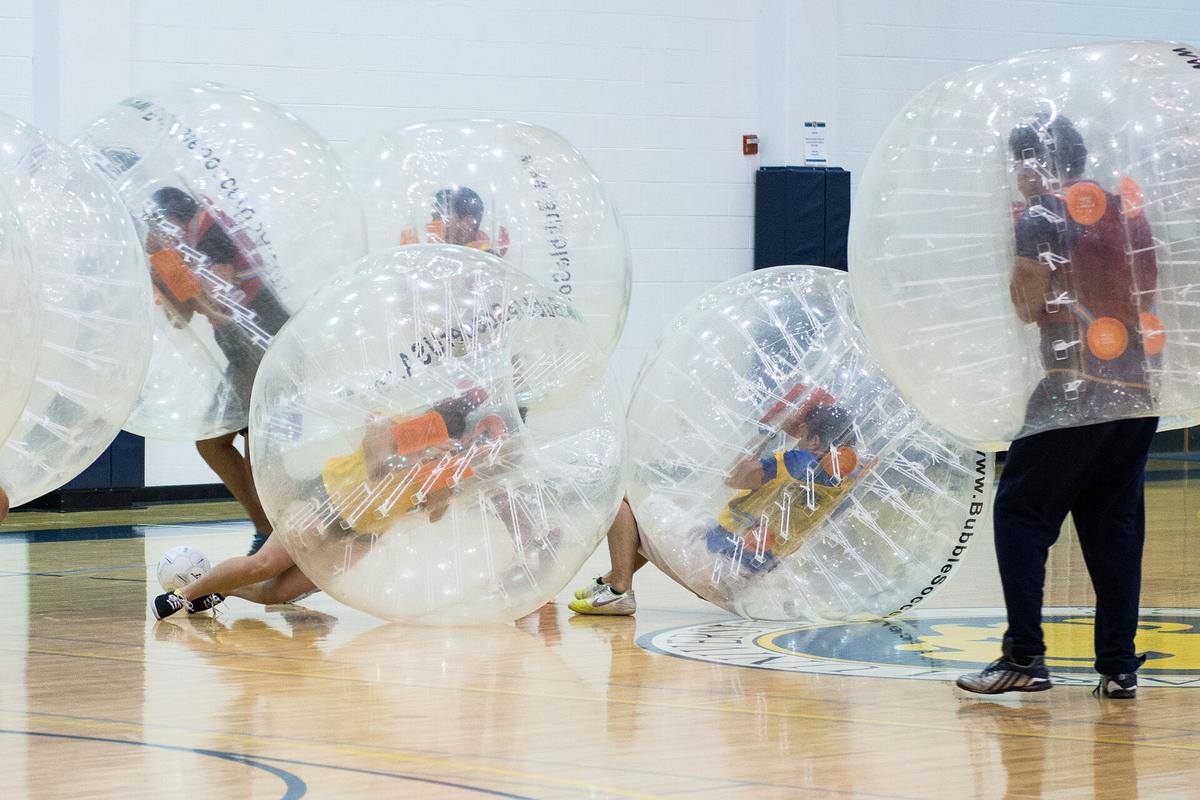
When two players collide in bubble soccer, the impact is absorbed by the inflated bladder, but the force transfers to the internal straps inside the suit. Those straps sit over your shoulders, and the suit's weight rides on top of that. If the suit is sized wrong, or if you are at the lower end of the height limit, the bubble's rim can rest against your head and transfer the entire collision force straight down your cervical spine. That is the mechanism behind the neck injury reports. It is why every provider in Singapore is required by the SS 626:2017 code of practice to ensure the suit rests on the shoulders, not the head, before play starts.
What participants actually report is different. The most common injuries on a bubble soccer pitch in Singapore are not neck injuries at all, they are lower limb twists. The suit restricts your leg movement. When you are running at full speed and get clipped, your ankle rolls and your knee twists. The suit's weight carries you forward while your foot stays planted. The zorb suit protects your head and torso, but it leaves your ankles and knees completely exposed. You can do everything right with your upper body and still blow out an ankle with a single awkward step. That is the gap between the marketing and the reality. It is the reason you need to know the height and weight limits before you book.
Height Requirements and Weight Limits in Singapore
Every provider in Singapore enforces a minimum height and a maximum weight, and these are not arbitrary numbers. The minimum height is 1.2 metres (120 cm), and some venues require 1.3 metres (130 cm). The maximum weight is 100 kg, with some providers allowing 110 kg. These figures come from the manufacturer's specifications for the suit, and the SS 626:2017 code of practice requires each business to set and enforce limits based on those specs and a formal risk assessment. Do not assume that a small adult can slip under the height limit by being light. The internal straps need a certain body mass to stay seated on your shoulders. A small adult can end up with the bubble riding up and hitting their chin on every collision.
The practical takeaway is this: if you are under 120 cm or over 100 kg, you cannot play, and no amount of persuasion will change that. Some businesses state a minimum age of 7, but a few venues require 10. That age limit exists because a 6-year-old often lacks the body mass to keep the straps seated. If you are bringing kids, check the specific age and size rules before you book. A birthday party that falls apart at the venue door is a failure you could have avoided. The staff will weigh and measure you, and the waiver you sign will include your medical declaration. There is no negotiation on this.
Protective Gear: What the Venue Provides and What You Must Bring
What You Get at the Venue
Bubble soccer protective gear Singapore venues provide is limited: the suit itself, which is a TPU or PVC bladder with internal straps, and some places throw in knee pads or shin guards. That is it. You are responsible for your own sports attire and covered shoes. No studs or blades if you are indoors; they tear up the sprung wooden or synthetic floor. Do not show up in football boots expecting to switch to outdoor turf. The majority of Singapore providers run their games indoors to escape the weather and heat. The venue will have the suits aired out and cleaned between rounds, but the enclosed, shared nature of the bubble means sweat and odour are a persistent user complaint that no business has fully solved. Bring a change of clothes and a towel.
The One Piece of Equipment That Matters Most
The internal straps inside the suit are the safety component that matters most. They must be adjusted to your height so that the suit's weight sits on your shoulders, not your neck. A badly fitted suit is the difference between a fun outing and a hospital trip. The facilitator should check every single player's straps before the first game. If they do not, that is your cue to walk out. The SS 626:2017 code of practice requires at least one trained facilitator per game, and first-aid trained personnel must be on site. A business that is not checking straps is a business that is not following the code.
Zorb Suit Safety: The Straps, the Falls, and the Get-Up
Zorb suit safety Singapore runs on a specific set of rules that the safety briefing hammers home before every match. The briefing lasts five to ten minutes, and it covers four non-negotiables: no head-on charging, no hitting players on the ground, no kicking the bubble, and the exit procedure if you feel unwell. That last one is not a formality. Heat exhaustion is a real risk during outdoor games in Singapore's 30°C-plus heat and 80-percent humidity, and the suit's insulating effect makes it worse. The briefing also covers how to fall. Falling is a skill in this sport. You fall sideways, not forward onto your hands. Do not try to break your fall with your arms; your lower limbs are the ones that will twist.
Getting up is the other skill. If you fall flat on your back, you cannot simply sit up. The suit's weight and the straps make it impossible without rolling onto your side first. The briefing will show you the roll-to-the-side and push-up method. You will need it within the first minute of the first game. Listen to the safety briefing as if your own knees depend on it. They do. The zorb suit does not protect your lower limbs. The single most common injury is a twisted knee or rolled ankle suffered by a player who took the briefing lightly.
Ankle and Knee Injury: What the Suit Does Not Protect
Bubble soccer ankle knee injury singapore is a phrase that should be on your mind before you step onto the pitch. The suit does nothing to prevent it. The bubble protects your head, your torso, and your shoulders. It does not brace your knees. It does not support your ankles. It leaves your lower legs free to pivot independently of your upper body. When two players collide at speed, the upper body bounces off the bubble, but the lower legs keep moving in the original direction. The knee joint takes the twist. Ankle sprains and knee ligament injuries are the most common reason a player leaves early. They happen on both indoor sprung floors and outdoor artificial turf.
The research is clear on the failure mode: the suit restricts lower-leg movement while encouraging full-speed collisions. You cannot avoid this by being careful. The entire point of the game is to collide. What you can do is control your own body. Do not run at a player who is stationary. Do not charge head-first, ever; that is how you transfer the collision force to your neck. If you have a pre-existing knee or ankle weakness, skip the game. The venue will not tell you this, but the waiver you sign is a medical declaration. The risk is on you, not on them. The key facts are simple: the suit protects the upper body, the lower limbs are exposed, and the most common injuries are twists, not breaks.
- Minimum height: 1.2 m (120 cm); some venues require 1.3 m (130 cm). Confirm the specific venue before booking.
- Maximum weight: 100 kg; some venues allow 110 kg. Check with the provider; limits come from manufacturer specs.
- Minimum age: 7 years for most Singapore providers; some require 10. Driven by strap sizing and insurance.
- Safety standard: SS 626:2017, published by Enterprise Singapore, requires impact-absorption and strap-strength tests.
- Facilitator ratio: At least one trained facilitator per game, with first-aid trained personnel on site.
- Neck protection rule: The suit must rest on the shoulders; the head must never bear the suit's weight.
- Heat management: Mandatory water breaks every 15-20 min when WBGT ≥31°C per SportSG's 2023 heat management guidelines.
The Safety Briefing and the Emergency Stop Signal
Every bubble soccer match in Singapore starts with a mandatory safety briefing. The content is not optional filler. The briefing covers the no-head-on-charging rule, the no-hitting-players-on-the-ground rule, and the no-kicking-the-bubble rule. It also covers the emergency-stop signal. This is your one tool to stop the game when something goes wrong. The signal is a raised hand and a shouted word. The moment it goes up, every player is expected to stop moving. This is not a suggestion; it is a rule that the facilitator enforces. It exists because the game is fast and the collisions are hard.
The briefing also covers how to exit if you feel unwell. This is not just about not wanting to play. It is about heat exhaustion. Outdoor matches are subject to the PUB lightning advisory, which is a hard stop. If lightning is within 6 to 8 km, the game stops immediately, no matter how much time is left. This is not at the venue's discretion; it is a national guideline from the PUB. Any business that ignores it is gambling with your safety. If you book an outdoor session, ask about the wet-weather policy before you pay. If they do not have one, find another provider.
Do not assume that a two-hour booking means you will be playing for two hours. The clock includes the briefing, the suiting-up, and the debrief. Expect around 90 minutes of actual play, split into game rounds of five to ten minutes each with breaks in between. The breaks are not just for rest; they are the hydration breaks the SportSG heat management guidelines require. On a hot day, the facilitator will call them more often. Drink water every single time, whether you feel thirsty or not.
The Weather Rules: PUB Lightning Advisory and Heat Exhaustion
Outdoor bubble soccer in Singapore runs into two weather realities, and both are non-negotiable. The first is the PUB lightning advisory, which requires all outdoor activities to cease when lightning is within 6 to 8 km. This is a hard stop, not a judgement call. When the sky goes dark and thunder rolls, the game stops immediately. The match either moves indoors or is cancelled. Do not book an outdoor slot and expect to get your full time if the weather turns. Cancellation policies vary, and some venues will not refund you for weather if the match has already started.
The second weather reality is heat exhaustion. Singapore's heat and humidity are brutal, and the suit makes it worse by trapping your body heat against your skin. The SportSG heat management guidelines, published in the 2023 revision by the Sports Safety Committee, require mandatory water breaks every 15 to 20 minutes when the wet-bulb globe temperature (WBGT) is at or above 31°C. That is a common condition in Singapore. Arrive hydrated. Drink during every break. Do not push through dizziness. If you feel faint, tell the facilitator and exit the suit. No one will think less of you.
Indoor venues remove the lightning risk and the heat problem. That is why the majority of Singapore providers run their matches indoors. Indoor sports halls have sprung wooden or synthetic floors, which are easier on the knees than concrete, and they have air-conditioning or at least better airflow. If you have the choice between an indoor and an outdoor venue, take the indoor one. You will play for longer, you will be more comfortable, and you will reduce your risk of heat-related injury.
Group Size, Ratio, and the Booking Reality
How Many Players You Need
Bubble soccer is a group activity, and in Singapore it runs on a group-booking model. The minimum group size is 8 to 10 participants, and the maximum per match is 30 to 40, depending on the venue and format. A small group can make the experience feel flat; the game needs enough players to sustain the match pressure. Too many players means long waits between turns and a facilitator stretched thin. The sweet spot is 12 to 20 players. That gives you a good game without excessive downtime.
The Facilitator Ratio That Keeps You Safe
The facilitator-to-group ratio is the number that matters for safety. The SS 626:2017 standard requires at least one trained facilitator per game, and a ratio of 1:15 is common. A lower ratio, more facilitators per player, means tighter safety oversight and faster game rotations. It also raises the cost to the business, which shows up in the price per person. When you are comparing providers, ask for the facilitator-to-group ratio for your specific booking size. If a business tells you that one facilitator can handle 30 players, that is a red flag. It might be within the letter of the law, but it is not a safe environment.
Book Ahead, Every Time
Do not expect to walk in without a booking. The walk-in model does not work for these businesses. They need to know the group size in advance to staff the match and prepare the suits. Book ahead. Confirm the group size, the height and weight limits, and the cancellation policy before you pay any deposit. If you are planning a school trip or a uniformed-group event, the venue will want to know your curriculum links and your safety ratio requirements in advance. Come prepared, and the booking will go smoothly.
What the Waiver Covers and What It Means for You
Before you pull on a bubble suit in Singapore, you will sign a liability waiver and a medical declaration. This is an insurance-driven constant across all combat and contact sports businesses, and it is not optional. The waiver confirms that you understand the risks, that you have no medical conditions that make the activity unsafe, and that you accept the insurance liability limits. Read it before you sign it. It is a legal document. The public liability insurance is mandatory under SportSG's advisory, and the waiver is the mechanism that transfers some of the risk from the business to you.
What the waiver does not cover is a failure to follow the SS 626:2017 standard. If the venue does not enforce the height and weight limits, does not check the straps, or does not stop the game during a lightning warning, the waiver is not a shield. The standard exists to protect you. A business that ignores it is negligent. Observe the conditions before you sign. Is the equipment in good repair? Is the facilitator checking every strap? Is the emergency-stop signal clearly explained? If the answer to any of these is no, do not sign. Walk away.
The medical declaration matters because some conditions make bubble soccer genuinely unsafe. Neck problems, back problems, and pregnancy are the big ones. If you have a history of cervical spine issues, do not play. The collision force can aggravate an old injury even if you feel fine on the day. The staff will ask, and you should answer honestly. Lying on a medical declaration is a way to void your insurance cover and to put yourself at real risk of harm.
Frequently Asked Questions About Bubble Soccer Safety in Singapore
What is the most common injury in bubble soccer in Singapore?
Ankle sprains and knee ligament twists are the most common injuries, not neck injuries. The zorb suit protects the upper body but leaves the lower limbs vulnerable to twisting when the suit's weight carries the body forward while the foot stays planted.
Can I play bubble soccer if I am over the weight limit?
No. The maximum weight limit is 100 kg for most providers, with some allowing up to 110 kg. These limits come from the manufacturer's specifications for the internal straps and the SS 626:2017 code of practice. Staff will weigh you, and exceeding the limit means you cannot play.
What should I wear to bubble soccer in Singapore?
Wear sports attire and covered shoes with no studs or blades if you are indoors. The venue provides the suit and may provide knee pads or shin guards. Bring a change of clothes and a towel; the suits are shared and the match is sweaty.
Is bubble soccer safe for children?
Most providers set a minimum age of 7, with some requiring 10. The age limit exists because younger children often lack the body mass to keep the straps seated on their shoulders. The minimum height is 1.2 metres, so a tall 6-year-old may be allowed if the venue's age policy permits it.
What happens if it rains during an outdoor match?
Outdoor matches are subject to the PUB lightning advisory, which requires play to stop when lightning is within 6 to 8 km. This is a hard stop. Ask about the wet-weather policy and cancellation terms before you book; policies vary between venues.
Do I need to book in advance?
Yes. Bubble soccer runs on a group-booking model with a minimum of 8 to 10 participants. Venues need to know the group size in advance to staff the match and prepare the equipment. Walk-ins are not viable and do not happen.
How do I know if a venue is following safety standards?
Ask if they operate under SS 626:2017, confirm the facilitator-to-group ratio is at least 1:15, observe whether they check every player's straps before play, and confirm the emergency-stop signal. A business that cannot answer these questions is not following the code.
The Honest Caveat: This Sport Demands an Honest Self-Assessment
Bubble soccer in Singapore is fun when you are within the limits and follow the rules. It is not a sport for everyone. If you have a weak knee, a bad ankle, or any existing neck or back condition, sit it out. The zorb suit protects you from the collision. It does not protect you from your own body's response to the impact. The most dangerous thing you can do is ignore a pre-existing injury because you want to play.
The safety framework in Singapore is real. The SS 626:2017 code of practice, the mandatory public liability insurance, the facilitator requirements, and the PUB lightning advisory all exist because someone tested this equipment and found the risks worth regulating. When you book with a reputable business that enforces the height and weight limits, checks the straps, and runs a proper safety briefing, you are playing under a system designed to let you have fun without going to hospital. The system only works if you participate in it. Show up fit, listen to the briefing, and be honest about your own limits.
.jpg)