What Is the Real Age Suitability for Bubble Soccer and How Do Kid-Sized Bubbles Work in Singapore?
Bubble soccer operators in Singapore often claim a minimum age of 7, but kid-sized bubbles are not universal and many young children lack the body mass to control a standard zorb suit safely.
What Is the Real Age Suitability for Bubble Soccer and How Do Kid-Sized Bubbles Work in Singapore?
Ask any operator in Singapore what the minimum age for bubble soccer is and you will get a clear, confident answer: 7. But that number alone does not answer the real question. Seven is the age at which insurers and operators let a child into a zorb suit. It is not the age at which most children can actually play. A typical 7-year-old lacks the body mass to control a standard adult bubble. Kid-sized bubbles are not universally available. Before you book a birthday party or a weekend slot, you need to know which suits the venue actually stocks, what the height and weight limits are, and whether the facilitator-to-child ratio will keep your child from being the smallest, slowest target on the pitch.
Why the Stated Minimum Age of 7 Hides a Deeper Problem
Insurance Rules Versus Physical Readiness
The minimum age sits in the fine print of every operator's waiver. They all say the same thing: 7 years old. That number is not a conspiracy. It is an insurance requirement. Public liability policies in Singapore are written so that operators can put a child of 7 into a zorb suit and have the waiver hold up if something goes wrong. But insurance minimums are about legal exposure, not physical readiness.
Here is what the operators will not tell you at the booking counter. The stated minimum age assumes an average child at the 50th percentile for height and weight. If your child is small for their age, the minimum age is effectively a lie for them. They will be allowed in, and they will spend the game being bounced around by children who outweigh them by 10 kg. The reverse is also true: a large 6-year-old might be physically capable of playing, but the operator will not let them on the pitch because the waiver says 7. Call ahead and ask what the actual suit sizes are, not what the age policy says.
What Kid-Sized Zorb Bubbles Actually Are
The Design Differences That Matter
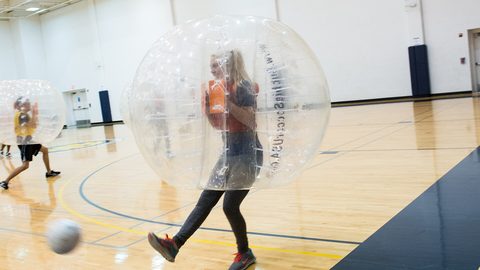
Kid-sized zorb bubbles appear at venues that have done the maths on keeping children safe. A kid-sized bubble suit is not a smaller version of the adult suit with the same proportions. It has a smaller diameter, typically 90-100 cm, against an adult suit's 120-150 cm. The weight is lower, 7-9 kg versus 10-15 kg for an adult suit. The harness inside is the critical difference: kid-sized suits have adjustable shoulder straps with hand grips, designed to fit a child's torso rather than an adult's. The suit's centre of gravity is lower. A child can actually shift their weight to change direction and brace for impact.
But here is the catch: not every operator in Singapore stocks kid-sized bubbles. The ones that do tend to be the dedicated bubble soccer venues that also run the party circuit. The ones that do not are often the multi-activity venues that offer bubble soccer as one of five games, sharing a single fleet of adult-sized suits. If you book at the wrong place, your 7-year-old will be told to put on a 120 cm suit that weighs more than a third of their body weight. The suit sizing chart should list the height and weight limits, but you cannot see it until you arrive. Ask for the suit dimensions over the phone, before you pay the deposit. If the venue cannot tell you the diameter of its smallest suit, it does not have one.
Bubble Soccer Height Weight Limit Children Singapore: The Numbers That Matter
No National Standard Exists
Bubble soccer height and weight limits for children get a vague answer from most operators. They have not standardised their fleets. The most commonly cited figure for the minimum height for kid-sized bubble suits is 100 cm, but that number comes from the manufacturer, not from a Singapore regulator. There is no national standard. The weight limit for kid-sized bubbles is around 40 kg. A child over that limit must use an adult suit, even if the height fits. The adult weight limit is around 100 kg. These numbers are published by the equipment makers and passed on by the operators, but they do not always match the reality of who is turned away at the door.
The practical issue is that the height and weight limits are usually verified by the facilitator at the briefing, not before. A child who is too small for the suit will have the harness ride up around their ears. That is both uncomfortable and dangerous. A child who is too heavy for the kid-sized suit will be asked to wear an adult suit and will then struggle to move it. The operator's own website will have a sizing chart, but it is rarely checked against the child's measurements until the moment of fitting. If you are booking for a child at the boundary, arrive 15 minutes early and ask for a test fit before the clock starts.
Which Operator Types Are More Likely to Stock Kid-Sized Bubbles
Dedicated Venues Versus Multi-Activity Centres
This is where the Singapore market splits. The dedicated bubble soccer operators, the ones that do nothing else, tend to have invested in a full range of kid-sized bubbles. They run children's parties every weekend. They know that a 7-year-old in an adult suit is a safety incident waiting to happen, so they bought the smaller suits. The multi-activity venues, the ones that offer bubble soccer alongside archery tag and laser tag, treat kid-sized bubbles as an optional extra. They will often have one or two small suits in the storeroom, but they will not guarantee their availability on a busy afternoon when the adult suits are all out.
Read the venue's website for the words 'kid-sized bubbles' or 'junior zorb'. If the site does not mention them, they are not in the fleet. Call and ask the direct question: how many suits do you have under 100 cm diameter? If the answer is 'we have a range', push for the number. A venue with 20 suits and only 4 kid-sized ones is a venue that will run a mixed-age game where your child is outnumbered by adults. The opposite is true at the dedicated venues: they run age-grouped slots where children 5-12 use kid-sized bubbles and 13 and above use adult-sized. That is the age grouping practice that actually protects kids.
Bubble Soccer Safety Kids Singapore: The Rules That Keep Children Out of Hospital
The Briefing and the Facilitator Ratio
Bubble soccer safety for kids starts with the safety briefing, which is not optional. The briefing covers the two rules that matter: body-to-body bumping only, and no head-on charges. The no-head-on rule is the one that gets broken. Children see the adult games on YouTube and try to copy the big hits. The briefing also covers the emergency stop, a signal the facilitator uses to halt play, and the safe zones where players can rest. The maximum recommended play time per individual before rest is 5-7 minutes continuous, after which the child should sit out for a few minutes. A 60-minute booking will include 3-5 games, with the clock including the briefings and water breaks.
The facilitator-to-participant ratio is the real safety control. The typical ratio is 1:15-20, but for children's events the venue should be running 1:10 or better. Ask what the ratio is for your child's slot, not what the brochure says. A ratio of 1:20 with 7-year-olds is a venue that is understaffed. The facilitator's job is not to referee the game. It is to stop the collisions that are too hard and to pull a child out when the suit is riding up or the child is showing signs of exhaustion. The neck collar on the suit is there for a reason: it prevents whiplash, but it only works if the suit is fitted correctly.
Ankle Twist Risk and Knee Injury in Bubble Soccer: The Hidden Injuries
Ankle twist risk and knee injury are the two most common injuries. They happen even in kid-sized suits. The zorb suit restricts lower-leg movement. The foot and ankle are in a fixed position while the upper body is free to twist. When a collision goes wrong, the upper body continues forward while the foot stays planted. That torques the knee. The suit does not protect the knee because it ends above the ankle, leaving the shin and knee exposed. Research from bubble football operators in the UK is consistent: the most common injuries are minor bruises and falls, but ankle sprains and knee ligament strains are the ones that take a child out for weeks.
To reduce the risk, the child should wear trainers, not football boots with studs. Studs grip the turf too well and increase the torque on a planted knee. The child should also be told to keep their legs slightly bent at all times. This lowers the centre of gravity and reduces the chance of falling backwards. They should never jump to head the ball. The suit's bulk makes a landing unpredictable. If the child has a history of ankle or knee problems, the activity is not worth the risk. There is no getting around the fact that bubble soccer is a collision sport.
Collision Force and Mixed-Age Sessions: Why Your 7-Year-Old Should Not Play Adults
Collision force is the reason a minimum age of 7 is not enough. A 7-year-old in a kid-sized suit will bounce off an adult in an adult suit with almost no transfer of energy. The adult suit is heavier and the adult is better balanced. But a 7-year-old in an adult suit, because the venue ran out of kid-sized ones, is a different story. The child is now in a suit that is 15 kg, moving at a speed they cannot control. The collision force is enough to knock them off their feet. The mixed-age game is where this happens. The venue will not turn away a paying adult just because there are children on the pitch.
Ask whether the slot is age-grouped. If it is not, and the group mixes 7-year-olds with 15-year-olds, the smaller child will be at risk. The child will also be at a disadvantage in terms of active play time. They will tire faster and spend their rest time watching the bigger kids have fun. The rule of thumb is simple: a child should only play in a group where every other player is within 20 kg of their weight. If the venue cannot guarantee that, book a private slot with a minimum group size of 8-10 participants. That way you control who is on the pitch.
Facilitator-to-Child Ratio and Briefing Comprehension
Briefing comprehension is the difference between a safe game and a chaotic one. The safety briefing is delivered to the whole group at once. It is usually in English, which may not be a child's first language. The facilitator will ask if everyone understands. The children will all nod, even the ones who have no idea what a safe zone is. For children under 10, the facilitator should repeat the briefing one-on-one at the edge of the pitch, or at least watch the child during the first game to check they are following the rules. A facilitator who is just going through the motions is a liability.
The facilitator-to-child ratio is the control that makes comprehension checkable. With a ratio of 1:10, the facilitator can spot the child who is about to attempt a head-on charge and stop them. With a ratio of 1:20, the facilitator is watching the whole pitch and will miss it. When you book, ask for the ratio in writing. If the venue refuses to confirm it, that is a sign that the ratio is not what they advertise. The parental consent waiver is required for all participants under 18. It must be signed before the child is allowed on the pitch. Do not sign it without reading the injury clause. That clause will hold the venue harmless for minor injuries. Check with the operator for the current wording.
The 60-Minute Session Is Really 45 Minutes of Play
The 2-hour booking is a myth. The 60-minute booking is only partly true. The clock includes the briefing, which takes 10-15 minutes, and the suiting-up, which takes another 5-10 minutes. The actual active play time in a 60-minute slot is 40-45 minutes. In a 90-minute slot it is 60-70 minutes. This is not a scam. It is just the logistics of getting a group into inflatable suits. But it matters for children. Forty-five minutes of continuous movement is a lot for a 7-year-old. The maximum recommended play time per individual before rest is 5-7 minutes. A child will need to sit out several times.
Book the 90-minute slot, not the 60-minute one, if your child is the type who needs a break every 5 minutes. The longer slot gives the child time to rest without missing the whole game. The number of games will be 3-5, depending on how long each one takes. The games are short, usually 5-10 minutes each, with a rest period in between. If the venue says the slot is 2 hours, assume 80 minutes of play at most. If it says 60 minutes, assume 45. Plan the rest of the day around those numbers.
What Happens When It Rains: The PUB Lightning Advisory
Singapore's weather does not care about your booking. The PUB lightning advisory is the rule that outdoor bubble soccer venues must follow: when lightning is within 6-8 km, play stops immediately. The National Environment Agency operates the lightning monitoring system. Venues with outdoor pitches will have a lightning alarm that sounds when the risk is high. When that alarm goes off, the game is paused and the group must go indoors. The venues will wait 30 minutes after the last lightning strike before resuming. That can eat into your time.
Ask whether the pitch is covered or fully outdoors. A covered pitch still has to stop for lightning. The metal blowers that keep the bubbles inflated attract strikes. A fully indoor venue is the only way around this. Most of the dedicated bubble soccer venues in Singapore are indoor, in industrial estates or shopping centre rooftops. If you book an outdoor venue during the monsoon season, which runs from November to January, check the wet-weather policy before you pay. The venue will usually offer a reschedule, but not a refund, if the game is cancelled due to weather. If the venue has no policy, book elsewhere.
Zorb Suit Hygiene: The Complaint No One Fixes
Zorb suit hygiene is a persistent complaint. It is not unfounded. The enclosed, shared nature of the suits makes sweat and odour an enduring issue that no venue has fully solved. The suits are made of TPU or PVC. They are not breathable. A child will sweat through a 45-minute game. The suits are cleaned with a disinfectant spray between groups, but the spray does not remove the smell, and it does not always kill bacteria. The harness and shoulder straps are the worst. They soak up sweat and are rarely washed separately.
Wear a long-sleeve top and leggings under the suit, not shorts and a t-shirt. The fabric protects the skin from rubbing against the inside of the suit, and it absorbs the sweat. Bring a towel and a full change of clothes, including socks. The suit will leave your child damp and smelling like a gym bag. Do not wear jewellery, including earrings and necklaces. They can catch on the harness. The venue will provide the bubble suit, but it will not provide a hairnet, so tie long hair back. If your child has sensitive skin, bring a barrier cream to put on the neck and wrists, where the suit seals.
How to Book the Right Session for Your Child
Private Bookings and Arrival Timing
Book a private slot if you have 8-10 participants. That is the minimum group size for a private booking, and it is the only way to guarantee that the group is not mixed with strangers. A private slot costs more per head than a public one, but it is the only way to control the age and weight range of the players. If you have fewer than 8 children, book a public slot and ask which times are least busy. Weekday afternoons are the quietest. The venue is more likely to have enough kid-sized bubbles for everyone.
Arrive 20 minutes before the start time, not 5. The briefing takes 10-15 minutes, and the venue will not delay it for latecomers. Bring a signed parental consent waiver for every child under 18. Make sure the child's name matches the ID you bring. The venue is required to check ID for the waiver to be valid. If you are booking for a birthday party, ask about the party-room availability. A dedicated air-conditioned space with tables for food and cake is a structural requirement that separates kid-viable venues from adult-only ones. Book the party room at the time of booking, not on the day. The popular weekend slots go a month in advance.
- Stated minimum age: 7 years (operator and insurance requirement)
- Typical kid-sized bubble diameter: 90-100 cm (adult suits are 120-150 cm)
- Kid-sized bubble weight: 7-9 kg (adult suits are 10-15 kg)
- Minimum height for kid-sized suit: Around 100 cm (manufacturer figure, varies by operator)
- Weight limit for kid-sized suit: Around 40 kg
- Weight limit for adult suit: Around 100 kg
- Maximum continuous play per child: 5-7 minutes before a rest
- Facilitator-to-participant ratio: 1:15-20 typical; 1:10 or better for children
- Active play in a 60-min session: 40-45 minutes after briefing and suiting-up
- Minimum group for private session: 8-10 participants
Frequently Asked Questions
What is the real minimum age for bubble soccer in Singapore?
The real minimum age is 7, as stated by most operators and driven by insurance requirements. But that age assumes a child has the size and weight to handle a kid-sized bubble suit. A small 7-year-old may not be ready, and a large 6-year-old cannot be admitted even if they are.
Are kid-sized bubbles available at every venue in Singapore?
No. Kid-sized bubbles are more common at dedicated bubble soccer venues that run children's parties. Multi-activity venues may have only one or two small suits, or none at all. Always call ahead to confirm.
What happens if my child is too small for the smallest suit?
The venue will not let them play, because the harness will not fit properly and the suit will be unsafe. They may offer a refund or a reschedule, but the game cannot proceed with an ill-fitting suit.
Can my child play in an adult-sized bubble if they are tall for their age?
Only if they are over 40 kg, which is the weight limit for kid-sized suits, and over 100 cm tall. But an adult suit is 120-150 cm in diameter and weighs 10-15 kg, so a small child will struggle to move it. It is not recommended.
What is the biggest risk of injury for a child in bubble soccer?
Ankle and knee injuries are the most common, caused by the suit restricting lower-leg movement while the upper body twists on impact. Minor bruises and falls are the most frequent injuries, but knee ligament strains can occur.
Is bubble soccer safe for a child with a pre-existing injury?
No. If the child has any history of ankle or knee problems, they should not play. The collision force and restricted movement put the joints at risk. Consult a doctor before booking.
Can I book a session if it is raining?
If the venue is outdoor, no, because the PUB lightning advisory requires play to stop when lightning is within 6-8 km. Check the venue's wet-weather policy before booking. Indoor venues are not affected.
The Honest Caveat About Bubble Soccer for Kids
The one thing no venue will tell you is this: if your child is under 7, do not push for an exception. The minimum age of 7 is not a suggestion. A venue that lets a 6-year-old play is a venue that has compromised its safety standards. A child that age lacks the coordination to control the suit and the judgment to follow the briefing. The game will not be fun for them, and it will be dangerous for everyone else on the pitch. Wait until they are 7, and then check that the venue stocks kid-sized bubbles. If it does not, find one that does.