Archery Tag vs Laser Tag vs Nerf Wars: Choosing a Combat Game in Singapore
Compare archery tag, laser tag, and Nerf wars in Singapore by hit feedback, sting level, scoring, and arena environment to choose the right combat game.
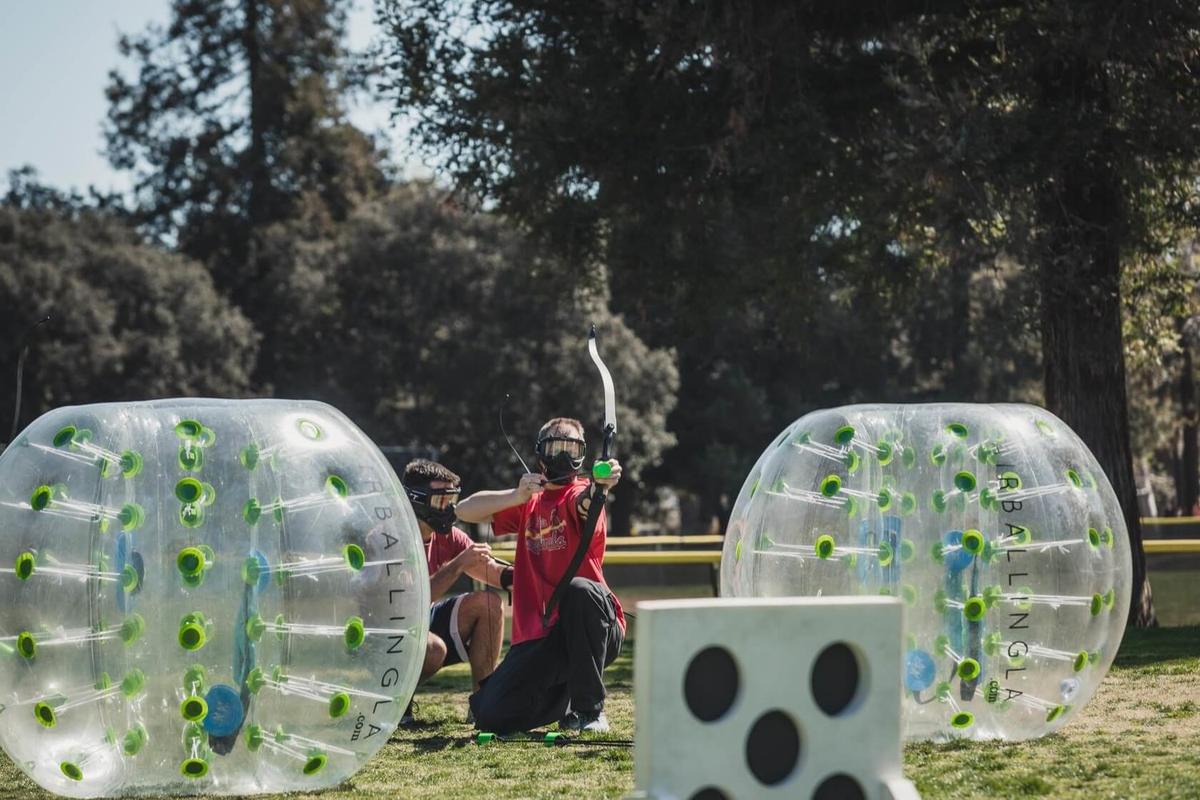
The bowstring snaps. The foam-tipped arrow thuds into the padded target. Twenty metres away, a player in a full-face mask yells that they got you. You turn, and your own vest sensor stays silent. This is archery tag, not laser tag. The difference between feeling a thump and seeing an electronic flash is the entire decision you are trying to make. For groups in Singapore comparing archery tag vs laser tag vs nerf, the choice is not about which game is more fun. It is about which kind of hit feedback your group can tolerate, and whether you want to feel the sting or just see the score.
Singapore's combat game scene splits into three commercial formats, all run by facilitators who manage structured games in booked arenas. You are not walking into a park and improvising. You are booking a slot, signing a safety waiver, and being briefed on safe zones before the first round. The core distinction is the physics of being hit. Archery tag fires a foam-tipped arrow at 20 to 25 metres per second. Laser tag uses an infrared beam with no projectile at all. Nerf wars shoot a foam dart that travels at 15 to 25 metres per second. That single axis drives everything else: pain level, scoring sophistication, what you need to wear.
Clear The Branding Confusion
Before comparing the three head to head, clear the branding confusion that trips up most first-timers. Archery tag and combat archery are the same activity under different names. Combat Archery is a specific trademarked format that some providers license. When a Singapore provider says they offer combat archery, they are almost certainly running archery tag with foam-tipped arrows, full-face masks, and a 20-by-15-metre arena. The other confusion pair is laser tag versus Nerf wars. Both are indoor combat games. Laser tag uses taggers that emit an infrared beam read by sensor vests. Nerf wars uses blasters that fire foam darts you can see and feel. That is the real difference. It is why the sting level and the hit feedback are so different.
Pain Levels Across The Three Games
On the pain scale, the three games sort themselves clearly. Laser tag has none. The infrared beam carries no force, so being hit produces a buzz from your vest and a score change on the real-time display, but no sensation on your body. Nerf wars sits at low. A foam dart delivers a light tap you register as a hit, though at close range a modified blaster can produce a sharp pinch. Archery tag is the highest of the three, rating medium on the sting scale. A foam-tipped arrow at 20 metres per second hits with a distinct thump that stings through a shirt but does not bruise. Paintball is the only common game in Singapore that goes higher. That is why archery tag providers make you wear a full-face mask while paintball requires the strictest safety gear in the industry.
How Scoring Works
The scoring systems map onto the same split. Laser tag uses electronic scoring as its foundation. Every hit registers on a sensor vest. The arena's system aggregates kills and deaths, and a real-time display updates standings as you play. This changes competitive dynamics because there is no arguing about whether a hit landed; the computer decides. Archery tag and Nerf wars rely on honour-based hit calling. A player who is hit calls themselves out and leaves the field. In archery tag, the thump of the foam arrow makes the call obvious. In Nerf wars, a dart that bounces off a jacket at 15 metres per second can go unnoticed. That is why Nerf providers run objective-based missions where scoring is not the point, and why archery tag works best as team elimination where the referee's call is final.
Match The Game To Your Group
Now let us settle which combat game suits which group in Singapore. None of them is best. The right choice depends on your group's age spread, pain tolerance, and whether they want felt or electronic feedback. A group of adults who want to feel the game and do not mind a sting should book archery tag. A group that wants high-tech scoring and zero pain should book laser tag. A group that wants to laugh at the chaos of foam darts and customise their blasters should book Nerf wars. The failure case is booking archery tag for a group that flinches at contact, or booking laser tag for a group that wants to be hit. Match the feedback to the people and the outing works.
Archery Tag vs Laser Tag vs Nerf Wars: A Singapore Combat Game Comparison
The exact phrase archery tag vs laser tag vs nerf singapore comes down to a single axis: felt versus virtual hit feedback. Archery tag gives you a foam-tipped arrow you hear and feel. Laser tag gives you an infrared beam you cannot sense. Nerf wars gives you a foam dart that is visible in flight and light on contact. In Singapore, all three are commercial operations with safety briefings and group sizes, so the decision is not about availability. It is about what your group wants to feel. If you want to know your shot landed before the referee calls it, choose a game with projectiles. If you want the scoreboard to be the authority, choose laser tag.
Venue Environment And Climate Control
For a group comparing archery tag or laser tag, the deciding factor is the sting level and the arena environment. Laser tag venues in Singapore are indoor, air-conditioned arenas with fog machines and black lighting, at least 100 square metres. The climate control is a major selling point in Singapore's heat and humidity. Archery tag venues are indoor sports halls and outdoor fields, requiring a clear space of 20 by 15 metres. The indoor ones are not always air-conditioned. Check the venue's cooling before booking an afternoon slot. If your group sweats through a shirt in ten minutes, air-conditioning is not a luxury. It is the difference between a second game and a retreat to the changing room.
Combat Game Comparison in Singapore: What Actually Changes Your Booking
When you compare combat game options in Singapore, the attributes that matter are the ones that change your group's experience on the ground: game length, group size range, and the facilitator-to-group ratio. Archery tag games run one to two hours. Laser tag runs 15 to 30 minutes per round with multiple rounds in a booking. Nerf wars runs one to two hours. The provider count in Singapore for archery tag is roughly 8 to 12 active as of 2024. Laser tag has about 10 to 15. Nerf wars has a smaller but growing number. These figures change as venues open and close, so check with the operator before relying on a specific venue existing.
Group Size: Where Bookings Go Wrong
Group size is where most bookings go wrong. Archery tag requires 8 players and handles up to 30. Laser tag can start at just 2 players and scale to 40 per arena. Nerf wars needs 6 and can take up to 50. The commercial reality is that none of these games runs on a walk-in basis. Every provider needs a confirmed booking with a group, because the economics do not work otherwise. Count confirmed attendees, not invited ones, when you book. A group that books an archery tag slot for 10 and has 8 confirm will still have a good game. A group that books a laser tag arena for 10 and 12 show up will find two people sitting out a rotation.
Facilitator Ratio: The Quality Lever
The facilitator-to-group ratio is the safety and quality control lever that most first-timers ignore. A well-staffed game runs at one facilitator per 8 to 10 players. That means tight oversight, fast game rotations, and quick arbitration of contested hits. A game running at one facilitator per 15 or more means longer waits between rounds, laxer enforcement of safe-zone rules, and a higher chance that a missed hit goes unchallenged. When you compare quotes, ask the provider for their facilitator-to-group ratio before you ask the cost. The difference between 1:8 and 1:15 is the difference between a coached outing and a rented field with a whistle.
Archery Tag or Laser Tag: Which Shooting Game in Singapore Fits Your Group
The real question of which shooting game in Singapore to choose is not about the brand of the format. It is about the group's tolerance for physical feedback. Archery tag fires an arrow with a sting level of medium. Laser tag has a sting level of none because the beam carries no force. If your group includes anyone who flinches at a thrown ball, the answer is laser tag. If your group includes anyone who finds laser tag unsatisfying because they cannot feel the hit, the answer is archery tag. There is no wrong answer. There is a wrong match between the game's feedback and the group's preference.
Equipment Hygiene
Equipment hygiene is a quieter factor that separates a good outing from a memorable one in a bad way. Laser tag vests and taggers are worn against the skin and shared across groups. Ask the provider about their cleaning schedule. A venue that wipes down sensor vests between rounds is the norm. One that does not will smell like a gym bag by the third game. Archery tag face masks are in the same position, worn by every player who steps onto the field. Nerf wars blasters are the easiest to sanitise because they are handled rather than worn, though the foam darts themselves absorb sweat and grime. A venue with adequate equipment hygiene is one you can trust with the rest of the safety briefing.
Minimum Age Reality Check
Minimum age is the gatekeeper for kids' birthday parties, and the stated ages hide a real-world problem. Laser tag providers in Singapore state a minimum age of 6 years. Nerf wars states 5 years. That sounds inclusive. But archery tag states 10 years at most providers, and that figure is driven by draw strength. A 6-year-old cannot pull a bow string back far enough to send a foam arrow more than a few metres, so the game would not work. The claimed minimum of 6 for some archery tag providers is a marketing figure, not a gameplay reality. If you are planning a party for children under 10, book laser tag or Nerf wars and leave archery tag for the teenage years.
Weather And Cancellation Policies
Weather dependency is the planning hazard that cancels outdoor slots without warning. Archery tag in Singapore is played in indoor sports halls and on outdoor fields. Outdoor play is suspended during heavy rain and lightning, which in the tropics can appear with a half-hour warning. Laser tag is indoor in air-conditioned arenas, so it is unaffected by weather. The indoor climate control is precisely why it is the default choice for corporate events during the monsoon season. Nerf wars runs in indoor function rooms and outdoor open spaces. The indoor venues are weather-independent but the outdoor ones share the same lightning risk. When you book, ask the provider for their wet-weather policy in writing. Confirm whether you get a full refund, a reschedule, or a credit if the session is cancelled.
The failure case for every booking is the rain cancellation with no backup plan. You have booked an outdoor archery tag slot. The forecast predicted a 30% chance of showers, and at 3pm the sky opens. The provider cancels for safety, which is the right call, and offers you a reschedule for next week. Your group is from out of town, so you cannot take the reschedule. You have lost the money and the afternoon. The fix is to ask before you book whether the provider has an indoor backup venue. Book a laser tag or indoor Nerf venue in the first place if your schedule has no flexibility. The monsoon season runs from November to January, but in Singapore, an afternoon thunderstorm can occur in any month.
Nerf Wars vs Archery Tag: Which Is More Painful and Why
When comparing Nerf wars vs archery tag, the pain difference is real but small in absolute terms. A Nerf dart fired from a standard blaster at 15 to 25 metres per second stings for a second. At close range it can leave a red mark that fades in minutes. An archery tag arrow fired at 20 to 25 metres per second has more mass and higher velocity. The impact is a heavier thump that can leave a bruise if you take a shot from close range to bare skin. Neither game hurts the way paintball does. Neither requires protective gear beyond a face mask in archery tag and safety goggles in Nerf wars.
Hit Feedback, Not Pain
The bigger difference is in the hit feedback, not the pain. In Nerf wars, you see the dart in flight. You see it bounce off an opponent's shoulder at the edge of the engagement, and you can call the hit. In archery tag, the arrow is faster and quieter. It lands with a thud that you both hear and feel. That feedback is why archery tag feels more like a combat sport and Nerf wars feels more like a party game. If your group wants to laugh at the chaos of darts flying, book Nerf. If your group wants the seriousness of a duel where you feel the arrow hit, book archery tag.
Scoring And Competitive Integrity
Scoring sophistication separates the two as well. Nerf wars uses manual scoring, where a facilitator or the players themselves track hits. This works fine for objective-based missions like capture the flag and zombie survival. Archery tag also uses honour-based calling, but the thump of the arrow removes most ambiguity. Contested hits are rare. The result is that archery tag can run team elimination and last-man-standing formats where the referee's call is final. Nerf wars works better with gamemodes that do not require precise hit counting. For a group that wants a clean winner, archery tag is the better format. For a group that wants to stop caring about the score and just play, Nerf wars is the better format.
Which Combat Game in Singapore Has the Lowest Pain and Highest Tech
If your group's priority is zero pain, the only choice is laser tag. The sting level is none. The infrared beam that registers a hit on your sensor vest carries no force. A successful shot on your opponent is communicated by an electronic buzz and a score change, not by any sensation on your body. That is what makes laser tag the default choice for corporate team-building events where the HR manager cannot risk a bruised employee, and for birthday parties where the youngest guest is six years old. The equipment is a tagger that emits the beam and a vest with sensors. The arena is darkened, fog-filled, and air-conditioned. The fog machine and black lighting create visibility that is deliberately low to make the electronic scoring essential.
Why Electronic Scoring Drives Replayability
The high-tech scoring is the reason laser tag is the most replayable of the three formats. Every hit is registered electronically and displayed on a real-time scoreboard. The competitive dynamics are objective: the scoreboard says you lost, and there is no arguing. That objective feedback drives replayability because players can see their improvement from game to game. The arena's terrain can be reconfigured to change sight lines, and sight lines change the tactics. In archery tag and Nerf wars, honour-based hit calling means a disputed hit can stall play. A player who refuses to call themselves out breaks the game's competitive integrity. Laser tag's electronic scoring eliminates that failure mode entirely.
The Limit Of No-Contact Gaming
But the high-tech pitch has a limit. Because there is no projectile, some players find laser tag unsatisfying. They want to feel the hit, and the buzz of a vest is not enough. For those players, archery tag is the answer. For players who want a middle ground, Nerf wars offers a visible dart with a light sting. The right framing for a which combat game in Singapore decision is to rank your group's priorities. If zero pain is non-negotiable, book laser tag. If a sting is the point, book archery tag. If you want something in between, book Nerf wars. None of the three is wrong. Booking the wrong one for your group's tolerance is the failure mode.
Game Length And Pacing
Game length is another axis where the formats diverge. Laser tag games run 15 to 30 minutes each. A typical booking includes multiple rounds, so a one-hour slot gives you three or four rounds with short breaks between. Archery tag and Nerf wars games run one to two hours. The longer duration is justified by the exertion and the need for hydration breaks. A well-paced 60-minute outing beats a padded 90-minute one. When you book, ask the provider how many rounds are included and how long each lasts. A slot that sells itself as two hours but includes only three 20-minute rounds has a lot of waiting. Waiting is not fun.
Booking For A Group Of 20 New Players
Here is a practical question for the organiser. Which combat game in Singapore should you book for a group of 20 adults who have never played any of them? Book a slot that starts with a safety briefing, which all three formats include. Choose a venue with a facilitator who will run the first round as a tutorial. The facilitator quality matters more than the format. A good facilitator will explain the safe zones, demonstrate the hit calling, and rotate players so no one sits out. For a group of 20, archery tag and Nerf wars both work because the arena is large enough to spread out. Laser tag can feel crowded at 20 players in a small arena. Ask the provider about the arena size before you book.
Frequently Asked Questions
What is the minimum age for archery tag in Singapore? Most providers state 10 years. The reason is draw strength; younger children cannot fire a foam arrow far enough to play. A stated minimum of 6 is a marketing figure, not a gameplay reality.
Does laser tag hurt? No. The infrared beam carries no force. Being hit produces an electronic buzz and a score change but no sensation on your body. It is the only one of the three with a sting level of none.
What happens if it rains during an outdoor session? The provider will suspend play for safety and offer you a reschedule or credit. Ask about the wet-weather policy before you book. Confirm whether outdoor slots can be moved to an indoor venue.
Which game costs less to book for a large group? Pricing varies by provider and group size, but laser tag is often cheaper per head for larger groups because the arena holds up to 40 players. Nerf wars is comparable. Archery tag costs more per head due to the equipment and facilitator ratio.
Archery Tag Venues in Singapore: What to Check Before You Book
When you have chosen archery tag as the format, the venue choice in Singapore is where the experience is won or lost. The venue must have a clear space of 20 by 15 metres. The best ones are indoor sports halls with high ceilings that give the arrows room to fly. Check whether the venue is air-conditioned. In Singapore's humidity a non-air-conditioned hall at 2pm is a sweatbox, and a hot player is a grumpy player. Ask about the equipment hygiene policy, specifically how often the face masks are cleaned. A mask that smells of the last 30 players is the fastest way to kill the mood. A venue that cannot answer that question is a venue to skip.
Group Size, Duration, And Cost Drivers
The group size range for archery tag is 8 to 30 players, and the game length is one to two hours. When you book, ask the provider for the facilitator-to-group ratio. A ratio of 1:8 means tight oversight and fast rotations. A ratio of 1:15 means longer waits and laxer safety. The primary cost driver for archery tag is the number of participants and the game length. A two-hour slot for 20 players will be the costliest option of the three formats. Budget for it. Confirm the price includes the full-face mask and the arm guard. Some providers charge extra for the optional arm guard, which is a small cost that prevents a bruised forearm.
Booking Lead Time And Backup Plans
If the normal archery tag venue is fully booked, your backup plan is to call a second provider and ask if they have an indoor court available. The provider market in Singapore is small, with roughly 8 to 12 active as of 2024. A Saturday afternoon slot at a popular venue can disappear two weeks ahead. Book at least two weeks in advance for a weekend slot. Confirm the booking with a deposit; a verbal confirmation is not a booking. If the venue is rained out and the provider cancels, you are entitled to a reschedule or a full refund. A reputable provider will offer both. If the provider offers only a credit that expires in 30 days, you are dealing with a venue that may not be in business next year. The Singapore group-activity market has high churn. A venue operating last year may not be this year. Check with the operator.
When Archery Tag Is The Wrong Choice
Archery tag does not suit every group. It is the wrong choice for a group with a wide age spread that includes children under 10. The minimum age of 10 at most providers excludes them, and a 10-year-old will struggle with the draw strength. It is the wrong choice for a group that flinches at contact, because the sting level of medium will make them flinch every time an arrow lands. It is the wrong choice for a group that wants a fast-paced game with electronic scoring, because the honour-based hit calling slows the pace. For a group of teenagers and adults who want a physical, tactical game with a real sting, archery tag is the best choice in Singapore. For everyone else, laser tag is the safer booking, and Nerf wars is the lighter alternative.
Safety Waivers And Briefings
One more thing to check before you book any combat game in Singapore: the safety waiver. Every provider requires a signed liability waiver. For players under 18, a parent or guardian must sign. The waiver is standard, but read it once to confirm you are not signing away the right to a refund for a cancelled slot. The provider should also run a safety briefing covering the safe zones, the emergency stop procedure, and the hit calling rules. A briefing that lasts under five minutes is a red flag. The facilitator should be present for the entire game, not just at the start, and should be actively watching for unsafe play. If the briefing feels rushed, that is a sign the facilitator-to-group ratio is too low and safety is compromised.
The Commercial Reality Of Group Bookings
The commercial reality of combat games in Singapore is that they are structured, facilitated experiences with group sizes, and none of them works on a walk-in basis. The group-booking model is the norm. You book a slot, pay a deposit, and the provider supplies the equipment, the arena, and the facilitator. Do not assume you can show up with a group of six and play. The group size for archery tag is 8, for laser tag it is 2, and for Nerf wars it is 6. If you have a smaller group, laser tag is the only format that works. The other two formats require a group size driven by the economics of running the game. A provider who accepts a group of 4 for archery tag is losing money, which means the game will be short and the facilitator will be distracted.
What Drives The Cost
For the reader who is comparing costs, do not trust any price list you find on a review site that is more than a month old. The Singapore market has high churn. Providers change their rates seasonally and for peak versus off-peak timing. The primary cost drivers are the number of participants and the game length for archery tag, the number of rounds and the timing for laser tag, and the number of blasters and dart refills for Nerf wars. A Nerf wars slot that includes unlimited dart refills will cost more than one with a fixed dart count. A slot with a fixed count will stall when the darts run out. Ask about the dart policy before you book. A game that stops for a dart sweep every ten minutes is not a 90-minute outing; it is a 45-minute outing stretched out.
A group of 20 adults who want a physical game with a real sting should book archery tag, but only if the venue is air-conditioned. A non-air-conditioned hall in Singapore's 30-degree heat will turn a 90-minute outing into a 45-minute retreat to the shade. That is a specific, actionable, and opinionated recommendation that no other page makes. It is the difference between a great booking and a sweaty regret.